
Related News

The Sombrero galaxy and its glowing halo of stars have never looked this good. The US National Science Foundation’s NOIRLab released the latest photo of the popular hat-shaped galaxy on

Researchers in China have discovered the 11th new lunar mineral, ‘Cerium–Magnesium Changesite,’ from the first Moon meteorites recovered in China. This important advancement, announced by the China Geological Survey, represents

China’s space mission (AP image) China has selected two Pakistani astronauts as candidates for its space programme, according to the state’s Manned Space Agency.In a statement issued on Wednesday, the

Challenge to Elon Musk’s SpaceX: Jeff Bezos’ Blue Origin to attempt first reused booster launch of New Glenn rocket Blue Origin, the US space company founded by Jeff Bezos, is

MUMBAI: Three days after the successful splashdown of Artemis-2, the Trump administration on Tuesday issued a memorandum which among other things includes safely deploying nuclear reactors in space orbit as

BENGALURU: In the vast hierarchy of the universe, the smallest galaxies are often overlooked. But a new study now suggests they may hold clues to one of astronomy’s most persistent

Trending News

In today’s digital age, the opportunity to make money online without any initial investment is more accessible than ever before. Whether you’re a student looking to earn some pocket money,

In today’s digital world, make money online has become a dream many want to turn into reality. Whether you’re looking for a side hustle or aiming to build a full-time

JSW Cement, the building materials arm of Sajjan Jindal-led JSW Group, has reduced the size of its upcoming initial public offering (IPO) to Rs 3,600 crore and will open the

The agricultural Gross Value Added (GVA) growth is expected to moderate to 4.5% in the first quarter of FY26, down from 5.4% in the preceding quarter, according to a report

Foreign portfolio investors (FPIs) turned net sellers in the Indian equity market in July, pulling out Rs 17,741 crore amid rising global trade tensions. According to data from NSDL, this

Avenue Capital Group-backed Asset Reconstruction Company (India) Ltd (ARCIL) has filed its draft red herring prospectus (DRHP) with markets regulator Sebi on Friday to raise funds through an initial public

NASA’s Perseverance discovers white kaolinite rocks on Mars, revealing millions of years of rainfall and wet conditions |

Word Count: 318 | Estimated Reading Time: 2 minutes


NASA’s Perseverance discovers white kaolinite rocks on Mars, revealing millions of years of rainfall and wet conditions

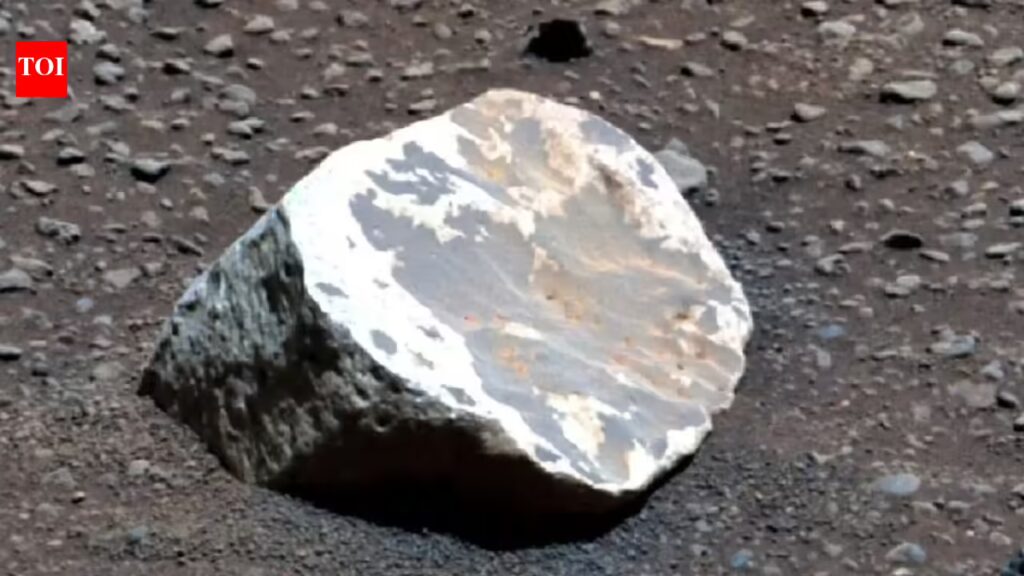
Bright white rocks. Scattered across the rusty red plains of Mars. NASA’s Perseverance rover spotted them in Jezero crater which the scientists have been staring at them ever since. At first glance, they might seem ordinary. But analysis tells a different story that these rocks aren’t just rocks. They’re kaolinite clays, aluminium-rich, and rare. On Earth, such clays form after millions of years of warm, wet rainfall. Rainfall that shapes landscapes. Finding them on Mars suggests the planet might once have had long periods of rain. Maybe millions of years.

NASA finds white kaolinite rocks on Mars, showing it once rained

The rocks were identified using Perseverance’s SuperCam and Mastcam Z instruments. Chemical analysis compared Martian clays with similar samples on Earth from California, South Africa, and other wet regions. Some scientists say the evidence is strong. But it’s still early. “It’s tricky,” Adrian Broz, a postdoctoral researcher at Purdue University, reportedly said. “Kaolinite requires long, sustained water exposure. That doesn’t happen easily.” Jezero crater once held a lake twice the size of Lake Tahoe. Rivers might have carried minerals across the region. Or perhaps asteroid impacts spread the white clays around. The exact origin remains uncertain.

Evidence of humid, wet periods on Mars

Professor Briony Horgan, planetary scientist at Purdue, points out that similar rocks are rare on Earth. They form slowly, under constant water exposure. On Mars, their presence hints at persistent wet conditions. Oases that might have lasted for millions of years. The clay fragments range from small pebbles to large boulders. Even tiny pieces carry chemical signatures of sustained rainfall. Experts say these challenges contradict older ideas of Mars as a frozen, mostly dry world.Perseverance’s instruments compared the Martian rocks with Earth analogues. SuperCam measures composition and mineralogy and provides high-resolution images. Rain seems the simplest explanation but it’s still a hypothesis.


Source link

Most Popular Articles