
Related News

Photo credit: PIB NEW DELHI: Indian Railways has approved running India’s first indigenous hydrogen fuel-cell-based train on the Jind-Sonipat section of the Northern Railway, entering the elite club of nations

The National Science Foundation on Thursday reversed a decision to dismantle a sprawling ocean monitoring network after vigorous objections from Democratic lawmakers and scientists who rely on it to track

Isro chairman V Narayanan (Right) NEW DELHI: Isro chairman V Narayanan has revealed that the space agency is collaborating with the Department of Atomic Energy (DAE) to develop an advanced

Patna: A monumental banyan tree (Ficus benghalensis) located on the Indian Tobacco Company (ITC) campus in Munger has been identified as one of the world’s oldest scientifically dated living trees

NEW DELHI: Unexpected side effects from medicines often come to light only after a drug is widely used. To strengthen monitoring of such cases, India’s drug regulator has directed pharmaceutical

Mathematical model reveals how ambitious you should be. A mathematical model has now cracked the exact degree to which one should be ambitious and unlike conventional wisdom, it says ‘don’t

Trending News

In today’s digital age, the opportunity to make money online without any initial investment is more accessible than ever before. Whether you’re a student looking to earn some pocket money,

In today’s digital world, make money online has become a dream many want to turn into reality. Whether you’re looking for a side hustle or aiming to build a full-time

JSW Cement, the building materials arm of Sajjan Jindal-led JSW Group, has reduced the size of its upcoming initial public offering (IPO) to Rs 3,600 crore and will open the

The agricultural Gross Value Added (GVA) growth is expected to moderate to 4.5% in the first quarter of FY26, down from 5.4% in the preceding quarter, according to a report

Foreign portfolio investors (FPIs) turned net sellers in the Indian equity market in July, pulling out Rs 17,741 crore amid rising global trade tensions. According to data from NSDL, this

Avenue Capital Group-backed Asset Reconstruction Company (India) Ltd (ARCIL) has filed its draft red herring prospectus (DRHP) with markets regulator Sebi on Friday to raise funds through an initial public

Hubble has spotted ‘impossible’ light in deep space, and scientists are trying to explain where it came from

Word Count: 411 | Estimated Reading Time: 3 minutes


Hubble has spotted ‘impossible’ light in deep space, and scientists are trying to explain where it came from

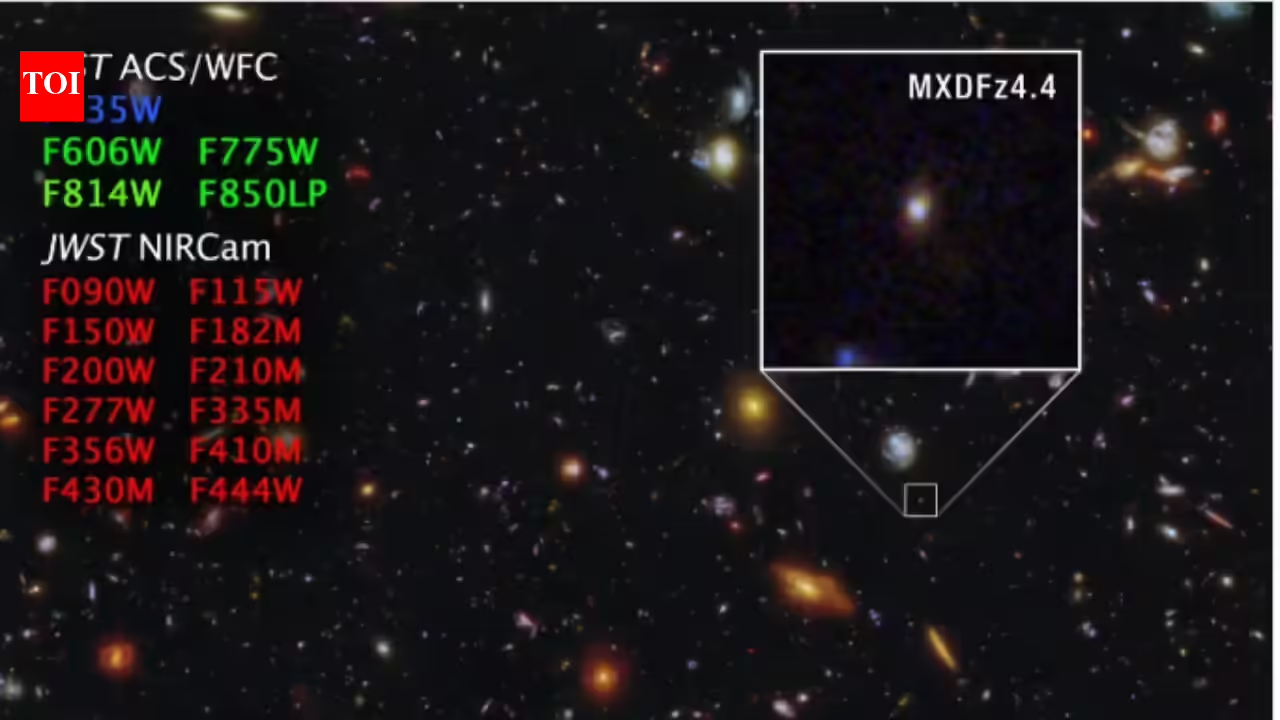
Astronomers have detected light from a tiny but powerful galaxy that existed when the universe was still emerging from a vast fog of hydrogen gas. The discovery, made using the Hubble Space Telescope and confirmed with data from the James Webb Space Telescope and a giant telescope in Chile, gives scientists one of their clearest views yet of a period once thought to be almost impossible to study.For hundreds of millions of years after the Big Bang, the universe was filled with neutral hydrogen that blocked much of the energetic ultraviolet light produced by the first stars and galaxies. Over time, that fog gradually cleared in a major transition known as the Epoch of Reionization. The newly studied galaxy, called MXDFz4. 4, appears to have punched through that fog.Researchers detected powerful ultraviolet light escaping from the galaxy and travelling across space, something never before seen from such an early period in cosmic history. The light began its journey only about 250 million years after the end of the Epoch of Reionization.

Tiny galaxy, outsized impact

MXDFz4. 4 is surprisingly small. Astronomers estimate that it covers an area roughly 100 times smaller than the Milky Way. Yet it is producing stars at an extraordinary pace of around 10 times faster than our galaxy.The intense burst of star formation packs huge numbers of young, massive stars into a compact region.According to the researchers, those stars may be carving channels through the galaxy’s gas, allowing energetic light to escape into intergalactic space.

Discovery by accident

The signal was found in October 2025 while Ilias Goovaerts of the Space Telescope Science Institute, was preparing an unrelated funding proposal.He checked a deep Hubble image to see whether anyone had searched for this kind of signal before. Within a couple of hours, he noticed something unusual.What followed was months of analysis using data from Hubble, the James Webb Space Telescope, and the European Southern Observatory’s Very Large Telescope.

Why astronomers are excited

Scientists think galaxies like MXDFz4. 4 may have helped transform the early universe by clearing away the hydrogen fog and allowing light to travel freely across space.So far, no other known galaxy from this early era has shown escaping ionising light this clearly. That makes MXDFz4. 4 a rare window into a time when the first galaxies were beginning to reshape the universe.Researchers now believe more such galaxies may be waiting to be discovered, hidden in the deepest images ever taken of the cosmos.


Source link

Most Popular Articles