


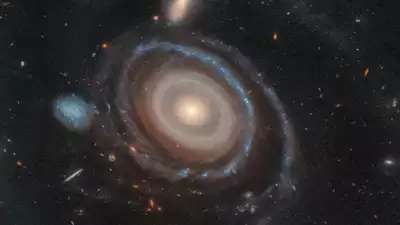
Nasa’s Hubble Space Telescope has captured a rare cosmic phenomenon—an enormous galaxy, LEDA 1313424, rippling with nine star-filled rings after being struck by a much smaller blue dwarf galaxy.
This incredible sight resembles a celestial bullseye and has more rings than ever detected in any galaxy.
The team’s findings were published on Tuesday in The Astrophysical Journal Letters under the title “The Bullseye: HST, Keck/KCWI, and Dragonfly Characterization of a Giant Nine-Ringed Galaxy.”
How was the ‘bullseye’ galaxy discovered?
The discovery was made by Imad Pasha, a doctoral student at Yale University, who first noticed the galaxy in a ground-based imaging survey.
“I was looking at a ground-based imaging survey and when I saw a galaxy with several clear rings, I was immediately drawn to it. I had to stop to investigate it,” Pasha was quoted as saying according to Nasa. The research team later nicknamed the galaxy the “Bullseye.”
Follow-up observations using Hubble and the WM Keck Observatory in Hawaii confirmed eight visible rings, with a ninth identified using Keck data. Previously, astronomers had only observed up to three rings in similar galaxies.
250,000 light-years wide galaxy
Astronomers found that the blue dwarf galaxy plunged straight through the centre of the Bullseye about 50 million years ago, much like an arrow hitting its target. The impact sent waves rippling through the larger galaxy, triggering new star formation.
A thin trail of gas connects the two galaxies, even though they are 130,000 light-years apart. The Bullseye galaxy is huge—250,000 light-years wide, more than twice the size of the Milky Way.
“We’re catching the Bullseye at a very special moment in time,” said Pieter G. van Dokkum, a Yale professor and co-author of the study. “There’s a very narrow window after the impact when a galaxy like this would have so many rings.”
The rings formed like ripples in water when a pebble is dropped. The first two spread out quickly, while the others appeared gradually. While most stars stayed in place, groups of them gathered over millions of years to form clear rings.
The gas was pushed outward, mixed with dust, and formed new stars, making the rings stand out more.
Long-standing prediction
This discovery also validated long-standing predictions about ring formation in galaxies.
“That theory was developed for the day that someone saw so many rings,” van Dokkum said. “It is immensely gratifying to confirm this long-standing prediction with the Bullseye galaxy.”
Hubble’s crisp vision was crucial in identifying most of the rings, while Keck confirmed an additional one.


