
Related News

The Sombrero galaxy and its glowing halo of stars have never looked this good. The US National Science Foundation’s NOIRLab released the latest photo of the popular hat-shaped galaxy on

Researchers in China have discovered the 11th new lunar mineral, ‘Cerium–Magnesium Changesite,’ from the first Moon meteorites recovered in China. This important advancement, announced by the China Geological Survey, represents

China’s space mission (AP image) China has selected two Pakistani astronauts as candidates for its space programme, according to the state’s Manned Space Agency.In a statement issued on Wednesday, the

Challenge to Elon Musk’s SpaceX: Jeff Bezos’ Blue Origin to attempt first reused booster launch of New Glenn rocket Blue Origin, the US space company founded by Jeff Bezos, is

MUMBAI: Three days after the successful splashdown of Artemis-2, the Trump administration on Tuesday issued a memorandum which among other things includes safely deploying nuclear reactors in space orbit as

BENGALURU: In the vast hierarchy of the universe, the smallest galaxies are often overlooked. But a new study now suggests they may hold clues to one of astronomy’s most persistent

Trending News

In today’s digital age, the opportunity to make money online without any initial investment is more accessible than ever before. Whether you’re a student looking to earn some pocket money,

In today’s digital world, make money online has become a dream many want to turn into reality. Whether you’re looking for a side hustle or aiming to build a full-time

JSW Cement, the building materials arm of Sajjan Jindal-led JSW Group, has reduced the size of its upcoming initial public offering (IPO) to Rs 3,600 crore and will open the

The agricultural Gross Value Added (GVA) growth is expected to moderate to 4.5% in the first quarter of FY26, down from 5.4% in the preceding quarter, according to a report

Foreign portfolio investors (FPIs) turned net sellers in the Indian equity market in July, pulling out Rs 17,741 crore amid rising global trade tensions. According to data from NSDL, this

Avenue Capital Group-backed Asset Reconstruction Company (India) Ltd (ARCIL) has filed its draft red herring prospectus (DRHP) with markets regulator Sebi on Friday to raise funds through an initial public

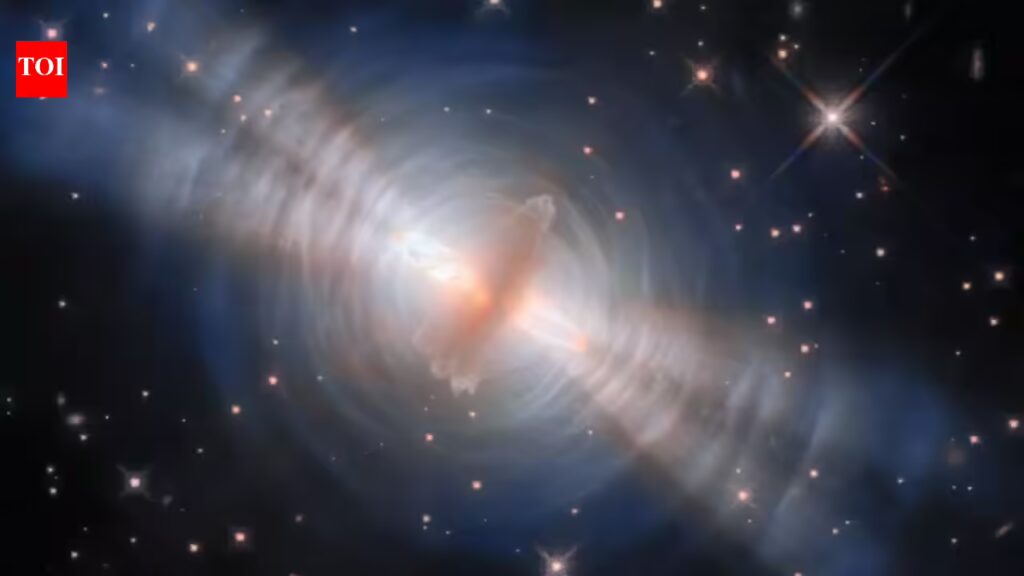
NASA Hubble Space Telescope captures rare view of dying star 1,000 light-years away in the Egg Nebula |

Word Count: 368 | Estimated Reading Time: 2 minutes


NASA Hubble Space Telescope captures rare view of dying star 1,000 light-years away in the Egg Nebula

1,000 light-years away in the constellation Cygnus, a sun-like star is reaching the closing chapter of its life. And it is not slipping away quietly. NASA’s Hubble Space Telescope has captured what many are calling the clearest view yet of the Egg Nebula, a glowing, swirling cloud of gas and dust created by this dying star. The image feels almost painterly. Blue-tinted shells. Twin beams of light. A bright centre that looks uncannily like a yolk, creating a rare chance to watch stellar evolution unfold almost in real time.

NASA Hubble captures the glowing ‘yolk’ of a dying star

The Egg Nebula gets its name from its unusual shape. At the centre sits the fading star, often described as the “yolk.” Around it spreads a hazy shell of gas and dust, as egg white suspended in space. It sounds whimsical. But the physics behind it is anything but simple.Unlike many nebulae that glow because their gases are ionised, the Egg Nebula shines mostly with reflected starlight. The light from the dying star punches through gaps in its thick, dusty shell. That is why we see those striking twin beams cutting outward. They almost look like searchlights. Experts say this stage is known as a pre-planetary nebula. It is a brief and fragile period in a star’s life.

What makes a pre-planetary nebula special

Planetary nebulae have nothing to do with planets directly. Early astronomers simply thought they looked planet-like through small telescopes. In reality, a pre-planetary nebula forms when a sun-like star begins shedding its outer layers. The core contracts and the outer gases drift outward. The Egg Nebula is reportedly the youngest and closest known example of this stage. That matters. Because it gives astronomers a front-row seat.Over time, the star’s core will grow hotter. It will eventually ionise the surrounding gas. When that happens, the nebula will glow in its own light, entering the next stage as a fully fledged planetary nebula.One of the most intriguing features in the new Hubble Space Telescope image is the symmetry. The arcs ripple outward in surprisingly neat layers. It seems unlikely that such orderly patterns would come from a chaotic supernova explosion.


Source link

Most Popular Articles