
Related News

The Sombrero galaxy and its glowing halo of stars have never looked this good. The US National Science Foundation’s NOIRLab released the latest photo of the popular hat-shaped galaxy on

Researchers in China have discovered the 11th new lunar mineral, ‘Cerium–Magnesium Changesite,’ from the first Moon meteorites recovered in China. This important advancement, announced by the China Geological Survey, represents

China’s space mission (AP image) China has selected two Pakistani astronauts as candidates for its space programme, according to the state’s Manned Space Agency.In a statement issued on Wednesday, the

Challenge to Elon Musk’s SpaceX: Jeff Bezos’ Blue Origin to attempt first reused booster launch of New Glenn rocket Blue Origin, the US space company founded by Jeff Bezos, is

MUMBAI: Three days after the successful splashdown of Artemis-2, the Trump administration on Tuesday issued a memorandum which among other things includes safely deploying nuclear reactors in space orbit as

BENGALURU: In the vast hierarchy of the universe, the smallest galaxies are often overlooked. But a new study now suggests they may hold clues to one of astronomy’s most persistent

Trending News

In today’s digital age, the opportunity to make money online without any initial investment is more accessible than ever before. Whether you’re a student looking to earn some pocket money,

In today’s digital world, make money online has become a dream many want to turn into reality. Whether you’re looking for a side hustle or aiming to build a full-time

JSW Cement, the building materials arm of Sajjan Jindal-led JSW Group, has reduced the size of its upcoming initial public offering (IPO) to Rs 3,600 crore and will open the

The agricultural Gross Value Added (GVA) growth is expected to moderate to 4.5% in the first quarter of FY26, down from 5.4% in the preceding quarter, according to a report

Foreign portfolio investors (FPIs) turned net sellers in the Indian equity market in July, pulling out Rs 17,741 crore amid rising global trade tensions. According to data from NSDL, this

Avenue Capital Group-backed Asset Reconstruction Company (India) Ltd (ARCIL) has filed its draft red herring prospectus (DRHP) with markets regulator Sebi on Friday to raise funds through an initial public

Mystery of the missing two-Sun planets may finally be solved: Einstein’s theory reveals why double-Sun worlds vanish |

Word Count: 431 | Estimated Reading Time: 3 minutes


Mystery of the missing two-Sun planets may finally be solved: Einstein’s theory reveals why double-Sun worlds vanish

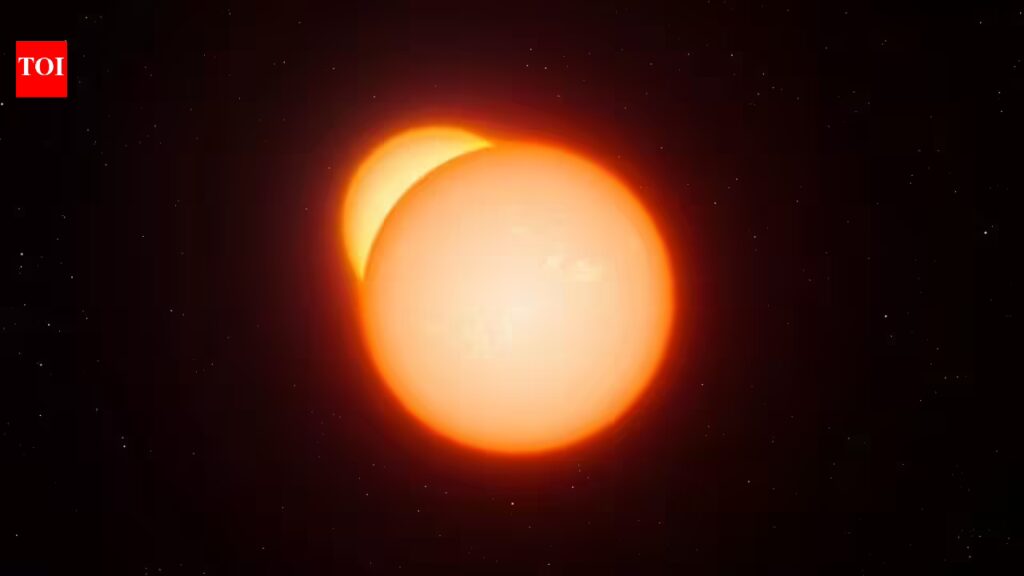
Astronomers have long wondered why planets orbiting two stars like the iconic Tatooine in Star Wars are so rare. You would expect them to be everywhere, really. Most stars form with planets, and a large fraction are born in pairs. Yet double-sun worlds are elusive. New research by University of Berkeley, suggests that the laws of physics, Einstein’s general relativity, could slowly push these planets into unstable orbits. Over millions of years, many get flung out or destroyed. What we see today is a skewed snapshot, a universe that appears emptier than it really is.

Why planets have a hard time orbiting two stars

Binary stars often orbit close together, and their gravitational pulls are anything but simple. A planet orbiting both feels a constantly changing tug. Its path slowly rotates, a process called orbital precession. It is a bit like a spinning top wobbling as it turns.The stars themselves precess too. General relativity plays a key role here. Over time, tidal forces pull them closer. That changes the game. The stars’ orbit speeds up, the planet slows down. Eventually, their rhythms match and chaos begins. When the precession rates align, the planet’s orbit stretches. At one point it swings far away, at another dangerously close to the stars. That is when trouble strikes.“Either the planet gets too close, or it is eventually ejected,” says Mohammad Farhat, a postdoc at UC Berkeley. “You end up losing the planet either way.”Only planets far from the stars survive. That is why circumbinary planets are rare. And it is not that they do not exist. They just avoid our telescopes. Planets in distant orbits rarely cross in front of their stars, making them invisible to Kepler or TESS.

Why planets rarely survive around close binary stars

Kepler and TESS expected to find hundreds of planets around tight binaries. Instead, only 14 confirmed circumbinary planets showed up, mostly orbiting stars that are not too tightly bound. A desert appears for binaries orbiting each other in less than seven days. That is exactly where we would expect to see them. Relativity and orbital chaos clear out that region.The universe makes these double-sun worlds rare, not because they cannot form, but because physics gently nudges them away from danger and often to their doom. The same physics behind Mercury’s orbit around the Sun explains it. Massive objects orbiting close together experience relativistic precession. For binary stars, the effect becomes dramatic over billions of years. The planet’s orbit is gradually warped until it either gets flung out or destroyed.


Source link

Most Popular Articles