
Related News

Archaeologists have deciphered a 1,700-year-old inscription at an ancient Roman temple in Turkey that offers rare written evidence of the shift from Mithraism to Christianity during the Roman period.The inscription

Photographic view during the Static Test of SOLVE-ST01 NEW DELHI: The Indian Space Research Organisation (ISRO) has successfully conducted the first ground test of the solid motor for its Sub-Orbital

Astronomers have detected light from a tiny but powerful galaxy that existed when the universe was still emerging from a vast fog of hydrogen gas. The discovery, made using the

Photo credit: PIB NEW DELHI: Indian Railways has approved running India’s first indigenous hydrogen fuel-cell-based train on the Jind-Sonipat section of the Northern Railway, entering the elite club of nations

The National Science Foundation on Thursday reversed a decision to dismantle a sprawling ocean monitoring network after vigorous objections from Democratic lawmakers and scientists who rely on it to track

Isro chairman V Narayanan (Right) NEW DELHI: Isro chairman V Narayanan has revealed that the space agency is collaborating with the Department of Atomic Energy (DAE) to develop an advanced

Trending News

In today’s digital age, the opportunity to make money online without any initial investment is more accessible than ever before. Whether you’re a student looking to earn some pocket money,

In today’s digital world, make money online has become a dream many want to turn into reality. Whether you’re looking for a side hustle or aiming to build a full-time

JSW Cement, the building materials arm of Sajjan Jindal-led JSW Group, has reduced the size of its upcoming initial public offering (IPO) to Rs 3,600 crore and will open the

The agricultural Gross Value Added (GVA) growth is expected to moderate to 4.5% in the first quarter of FY26, down from 5.4% in the preceding quarter, according to a report

Foreign portfolio investors (FPIs) turned net sellers in the Indian equity market in July, pulling out Rs 17,741 crore amid rising global trade tensions. According to data from NSDL, this

Avenue Capital Group-backed Asset Reconstruction Company (India) Ltd (ARCIL) has filed its draft red herring prospectus (DRHP) with markets regulator Sebi on Friday to raise funds through an initial public

Meet Robert Goddard: The man behind a 2.5-second rocket crash that shaped 100 years of NASA spaceflight |

Word Count: 362 | Estimated Reading Time: 2 minutes


Meet Robert Goddard: The man behind a 2.5-second rocket crash that shaped 100 years of NASA spaceflight

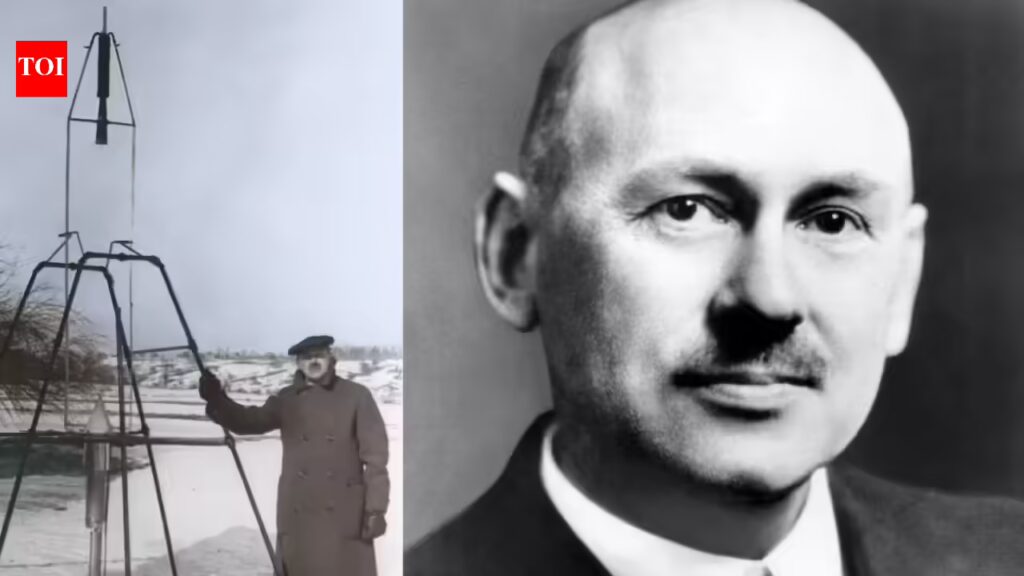
A century ago, in a quiet cabbage patch in Auburn, Massachusetts, something happened. Dr Robert H. Goddard, a Clark University Physics professor, fired up a rocket powered by liquid fuel. It flew for a mere 2.5 seconds and landed in a cabbage patch 184 feet (56 meters) as reported by NASA. This little test, on March 16, 1926, reportedly changed the way humans would explore the skies. Liquid-fuelled rockets were born. And from that modest flight came a century of exploration that would carry satellites, probes, and eventually astronauts far beyond our world.

Robert Goddard’s early rocket experiments that revolutionised liquid fuel technology and spaceflight

The fuel mixture was liquid oxygen and gasoline, that is a strange combination back then. Most rockets relied on solid propellants. Once lit, they burned out with no control. Goddard’s approach was different. Liquid fuel meant he could throttle, control, maybe even steer. His first flight was tiny in scale, sure. But it demonstrated that controlled, powered flight was possible. Within a few seconds, just forty feet. Over the years, Goddard didn’t stop. He worked on pumps, engines, and guidance systems. Small tweaks that would become essential. They feed fuel into engines at incredible pressures.From his cabbage patch tests to later launches in New Mexico, Goddard laid the groundwork for every major launch vehicle in history. The usage of liquid-fueled rockets has been a key in the exploration of space, from voyages of spacecraft to the Moon and beyond. On March 16, 2026, it marks 100 years since the first successful test of this technology.

How Goddard’s idea still powers NASA today

Fast forward a hundred years. NASA’s Artemis 2 mission is set to orbit the Moon. The rocket is 322 feet tall. Fueled by a mixture of liquid hydrogen and oxygen, topped with solid boosters. Liquid fuel still powers the main engine. Solid boosters still help lift off. And just like that first tiny rocket, the spark ignites a journey into the unknown.It looks odd to think a 2.5-second flight could lead here. Yet each Artemis mission builds on history. Artemis 2 is a shakedown, testing Orion’s life support. Artemis 3 and 4 aim for lunar orbit and landing.


Source link