
Related News

The Sombrero galaxy and its glowing halo of stars have never looked this good. The US National Science Foundation’s NOIRLab released the latest photo of the popular hat-shaped galaxy on

Researchers in China have discovered the 11th new lunar mineral, ‘Cerium–Magnesium Changesite,’ from the first Moon meteorites recovered in China. This important advancement, announced by the China Geological Survey, represents

China’s space mission (AP image) China has selected two Pakistani astronauts as candidates for its space programme, according to the state’s Manned Space Agency.In a statement issued on Wednesday, the

Challenge to Elon Musk’s SpaceX: Jeff Bezos’ Blue Origin to attempt first reused booster launch of New Glenn rocket Blue Origin, the US space company founded by Jeff Bezos, is

MUMBAI: Three days after the successful splashdown of Artemis-2, the Trump administration on Tuesday issued a memorandum which among other things includes safely deploying nuclear reactors in space orbit as

BENGALURU: In the vast hierarchy of the universe, the smallest galaxies are often overlooked. But a new study now suggests they may hold clues to one of astronomy’s most persistent

Trending News

In today’s digital age, the opportunity to make money online without any initial investment is more accessible than ever before. Whether you’re a student looking to earn some pocket money,

In today’s digital world, make money online has become a dream many want to turn into reality. Whether you’re looking for a side hustle or aiming to build a full-time

JSW Cement, the building materials arm of Sajjan Jindal-led JSW Group, has reduced the size of its upcoming initial public offering (IPO) to Rs 3,600 crore and will open the

The agricultural Gross Value Added (GVA) growth is expected to moderate to 4.5% in the first quarter of FY26, down from 5.4% in the preceding quarter, according to a report

Foreign portfolio investors (FPIs) turned net sellers in the Indian equity market in July, pulling out Rs 17,741 crore amid rising global trade tensions. According to data from NSDL, this

Avenue Capital Group-backed Asset Reconstruction Company (India) Ltd (ARCIL) has filed its draft red herring prospectus (DRHP) with markets regulator Sebi on Friday to raise funds through an initial public

How long does it take the sun to rotate on its axis |

Word Count: 398 | Estimated Reading Time: 2 minutes


How long does it take the sun to rotate on its axis

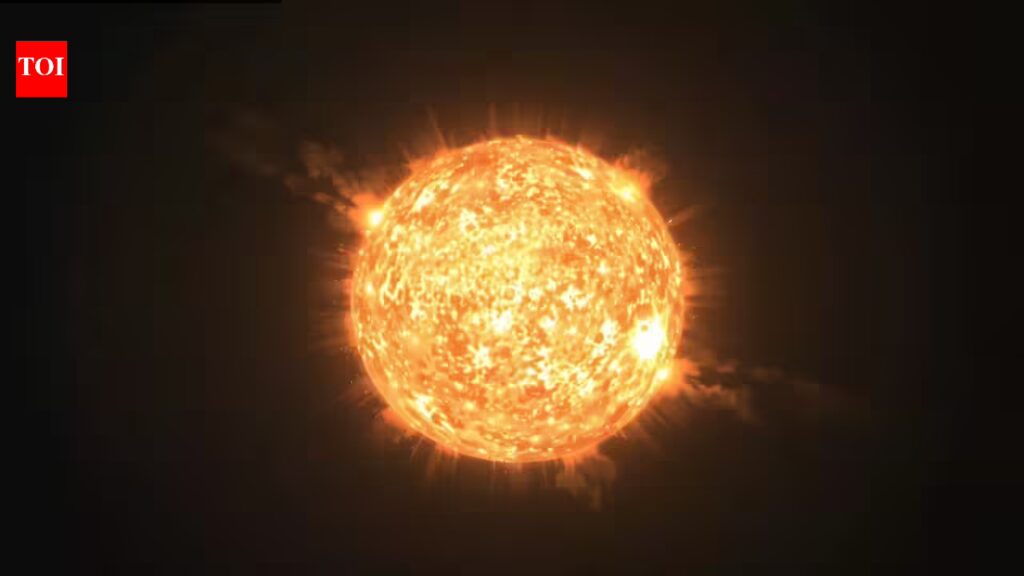
The Sun turns, but not in the way a solid object would. It has no hard surface, no fixed edge to follow. What scientists describe as solar rotation comes from watching patterns move across a glowing, restless face. That motion matters because it shapes the Sun’s behaviour, from quiet stretches to bursts of activity. Over decades, observations have settled on broad timescales rather than exact figures. The result is an answer that depends on where you look and how closely you choose to look. The Sun rotates, but it does so unevenly, and that unevenness is part of its nature.

The sun takes 25 Earth days to rotate on its axis

The most widely used measure of the Sun’s rotation comes from watching sunspots drift across its face. Near the equator, the Sun completes one rotation in about 25 Earth days. Closer to the poles, that same turn takes closer to 36 days. This difference happens because the Sun is made of plasma, not solid rock, allowing regions to move more freely.

Rotation slows toward the solar poles

Away from the equator, the pace changes. Near the poles, a full spin takes closer to 36 days. The transition is gradual rather than sharp. Latitude by latitude, the surface drifts at slightly different rates. This pattern, known as differential rotation, is a basic feature of the Sun and has been observed for more than a century.

Sunspots reveal how rotation is measured

Sunspots operate as markings on the solar surface. By observing how long they take to resurface at the same spot, researchers determine rotation rates. Measurements are averages rather than exact clocks since these dark areas dissipate and regenerate. Over time, patterns form, but tiny differences remain.

The Sun’s slow spin shapes solar activity

Rotation silently shapes the Sun’s magnetic field. As the areas move at varying speeds, magnetic lines stretch and twist. Although the association is gradual rather than direct, this mechanism plays a role in solar flares and eruptions. Years, not days, are when changes take place.

The Sun rotates while moving through the galaxy

While spinning on its axis, the Sun is also travelling around the centre of the Milky Way. One full orbit of the galaxy takes about 230 million Earth years. Against that scale, the Sun’s rotation feels brief, almost incidental, yet it remains central to how our star behaves and changes over time.


Source link

Most Popular Articles