


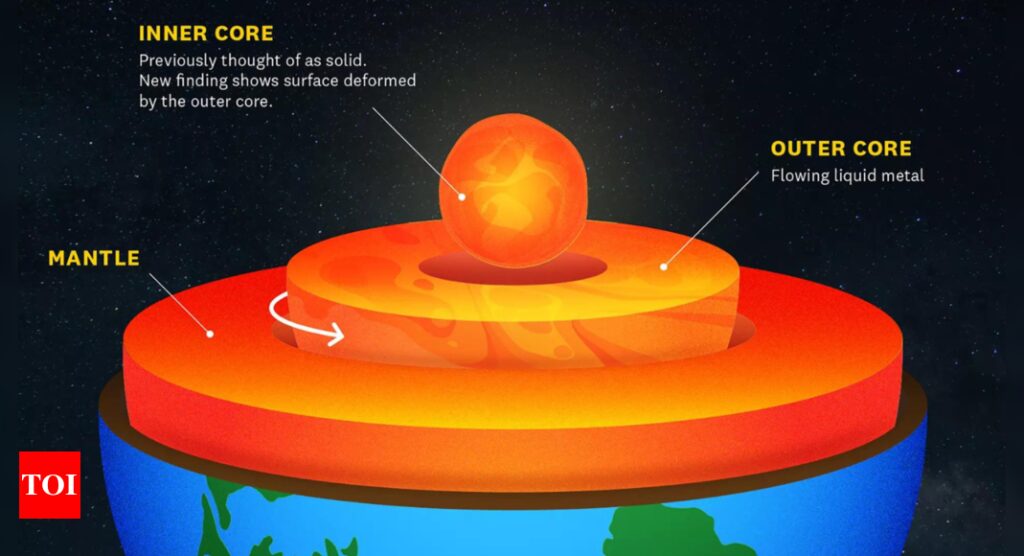
The inner core at the centre of the Earth, a ball of iron and nickel about 1,500 miles wide, may not be perfectly solid. A new study finds evidence that the inner core’s outer boundary has noticeably changed shape over the past few decades. “The most likely thing is the outer core is kind of tugging on the inner core and making it move a little bit,” said John Vidale, earth sciences professor at University of Southern California.
Vidale and his colleagues reported their findings Monday in the journal Nature Geoscience. That adds to the mysteries about the planet’s centre. Geophysicists have previously reported that the inner core does not spin at exactly the same rate as the rest of the Earth. They also showed that the pace of rotation changes – the inner core appeared to be spinning slightly faster than outer layers a couple of decades ago, and now it is spinning slightly slower.
The inner core is the deepest of Earth’s geological layers. The crust – the layer that we live on – is just a few miles thick. Below that, filling up 84% of the planet, is the 1,800-mile-thick mantle, which is soft enough in places to flow up and down and generate the forces that push the continents around. Between the mantle and the inner core is the liquid outer core.
For this study, Vidale and his colleagues looked at earthquakes in the South Sandwich Islands, a volcanic chain in the South Atlantic Ocean. The scientists identified more than 100 such “earthquake pairs”, analysing readings from 1991 to 2004 at two arrays of seismometers more than 8,000 miles away from the islands, one near Fairbanks, Alaska, the other in Yellowknife, in Canada’s Northwest Territories. Identical earthquake vibrations passing through the identical part of the Earth should have produced identical seismic signals at Fairbanks and Yellowknife. At Fairbanks, that was true, but at Yellowknife the signals were different. That suggested something had changed near the outer boundary of the inner core.
Turbulent flow in the outer core or gravitational pull from denser parts of the mantle could have deformed the inner core boundary, which might account for the change in the seismic signals, Vidale said. “We expect it’s soft because it’s near melting point,” he said. “So it’s no surprise if it deforms.”
In recent years, geophysicists have argued over whether differences in the seismic signals are caused by a change in the rotation rate or by a change in the shape of the inner core. “The study thus reconciles the last debate by proposing a combination of both causes,” said expert Hrvoje Tkalcic.


