
Related News

NASA’s Jet Propulsion Laboratory recently reached a significant achievement in space travel technology. They successfully tested a lithium-fed magnetoplasmadynamic (MPD) thruster, establishing a domestic power milestone for power output in

While staying at the Imperial Hotel in Tokyo during a lecture tour, Albert Einstein found himself in an awkward situation. A hotel bellboy had delivered a message to his room,

Have you ever wondered why rockets eventually tilt themselves after launch? Most people assume a rocket’s goal is to fly as high as possible, but ‘up’ is only the first

The Sombrero galaxy and its glowing halo of stars have never looked this good. The US National Science Foundation’s NOIRLab released the latest photo of the popular hat-shaped galaxy on

Researchers in China have discovered the 11th new lunar mineral, ‘Cerium–Magnesium Changesite,’ from the first Moon meteorites recovered in China. This important advancement, announced by the China Geological Survey, represents

China’s space mission (AP image) China has selected two Pakistani astronauts as candidates for its space programme, according to the state’s Manned Space Agency.In a statement issued on Wednesday, the

Trending News

In today’s digital age, the opportunity to make money online without any initial investment is more accessible than ever before. Whether you’re a student looking to earn some pocket money,

In today’s digital world, make money online has become a dream many want to turn into reality. Whether you’re looking for a side hustle or aiming to build a full-time

JSW Cement, the building materials arm of Sajjan Jindal-led JSW Group, has reduced the size of its upcoming initial public offering (IPO) to Rs 3,600 crore and will open the

The agricultural Gross Value Added (GVA) growth is expected to moderate to 4.5% in the first quarter of FY26, down from 5.4% in the preceding quarter, according to a report

Foreign portfolio investors (FPIs) turned net sellers in the Indian equity market in July, pulling out Rs 17,741 crore amid rising global trade tensions. According to data from NSDL, this

Avenue Capital Group-backed Asset Reconstruction Company (India) Ltd (ARCIL) has filed its draft red herring prospectus (DRHP) with markets regulator Sebi on Friday to raise funds through an initial public

Clouds that condense into diamonds: NASA discovers an exoplanet with a baffling composition

Word Count: 375 | Estimated Reading Time: 2 minutes


Clouds that condense into diamonds: NASA discovers an exoplanet with a baffling composition

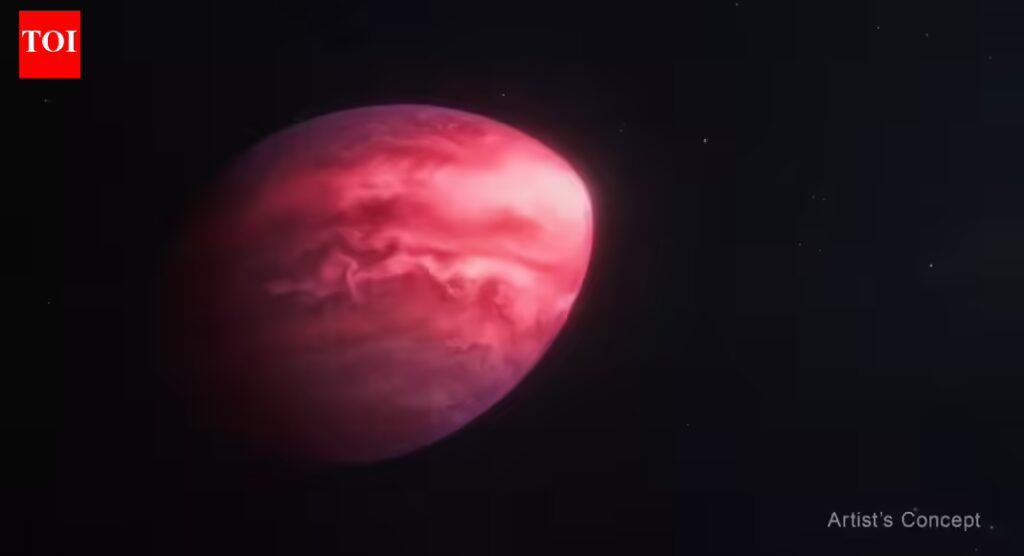
NASA’s James Webb Space Telescope (JWST) has recently discovered a rare exoplanet, whose composition has baffled scientists as it defies all explanations. Officially named PSR J2322-2650b, the Jupiter-sized planet is outside our solar system and its atmospheric composition challenges our understanding of how it was formed. It orbits a pulsar, a rapidly spinning neutron star, just 1 million miles away and makes its year a mere 7.8 hours. A paper published in The Astrophysical Journal Letters, detailed that the planet has an exotic helium-and-carbon-dominated atmosphere where soot clouds float through the air. Deep within the planet, these carbon clouds condense and form diamonds. This composition is unprecedented among the 150 planets studied in detail, with no oxygen or nitrogen present. “This was an absolute surprise,” said study co-author Peter Gao of the Carnegie Earth and Planets Laboratory in Washington to NASA. “I remember after we got the data down, our collective reaction was ‘What the heck is this?’ It’s extremely different from what we expected.”

An extremely unique composition

The distant planet appears to be in the shape of a lemon as the pulsar’s intense gravity stretches the planet. It is unique because the scientists are able to see the planet illuminated by the host star but not the host star. It orbits a star that’s “completely bizarre” with the mass of the Sun but the size of a city. Additionally, unlike the usual molecules found in an exoplanet like water, methane and carbon dioxide, this one has molecular carbon, specifically C3 and C2. Temperatures on the planet range from 1,200 degrees Fahrenheit at the coldest points of the night side to 3,700 degrees Fahrenheit at the hottest points of the day side.The International Astronomical Union defines an exoplanet as a celestial body below 13 Jupiter masses that orbits a star, brown dwarf, or stellar remnant, such as a pulsar. Of the 6,000 discovered exoplanets, this is the only one reminiscent of a gas giant orbiting a pulsar. “But it’s nice to not know everything,” said study co-author Roger Romani, of Stanford University and the Kavli Institute for Particle Astrophysics and Cosmology Institute to NASA. It seems the mysteries of the universe are ever-evolving and this one has scientists awestruck to explore and excited to solve.


Source link

Most Popular Articles