
Related News

According to JAXA, the entire flight lasted about 40 seconds. Japan has taken a significant step towards developing reusable rocket technology after its space agency successfully carried out the first

Archaeologists have deciphered a 1,700-year-old inscription at an ancient Roman temple in Turkey that offers rare written evidence of the shift from Mithraism to Christianity during the Roman period.The inscription

Photographic view during the Static Test of SOLVE-ST01 NEW DELHI: The Indian Space Research Organisation (ISRO) has successfully conducted the first ground test of the solid motor for its Sub-Orbital

Astronomers have detected light from a tiny but powerful galaxy that existed when the universe was still emerging from a vast fog of hydrogen gas. The discovery, made using the

Photo credit: PIB NEW DELHI: Indian Railways has approved running India’s first indigenous hydrogen fuel-cell-based train on the Jind-Sonipat section of the Northern Railway, entering the elite club of nations

The National Science Foundation on Thursday reversed a decision to dismantle a sprawling ocean monitoring network after vigorous objections from Democratic lawmakers and scientists who rely on it to track

Trending News

In today’s digital age, the opportunity to make money online without any initial investment is more accessible than ever before. Whether you’re a student looking to earn some pocket money,

In today’s digital world, make money online has become a dream many want to turn into reality. Whether you’re looking for a side hustle or aiming to build a full-time

JSW Cement, the building materials arm of Sajjan Jindal-led JSW Group, has reduced the size of its upcoming initial public offering (IPO) to Rs 3,600 crore and will open the

The agricultural Gross Value Added (GVA) growth is expected to moderate to 4.5% in the first quarter of FY26, down from 5.4% in the preceding quarter, according to a report

Foreign portfolio investors (FPIs) turned net sellers in the Indian equity market in July, pulling out Rs 17,741 crore amid rising global trade tensions. According to data from NSDL, this

Avenue Capital Group-backed Asset Reconstruction Company (India) Ltd (ARCIL) has filed its draft red herring prospectus (DRHP) with markets regulator Sebi on Friday to raise funds through an initial public

Can yeast survive on Mars? IISc, Isro scientists find promising clues

Word Count: 700 | Estimated Reading Time: 4 minutes


Can yeast survive on Mars? IISc, Isro scientists find promising clues
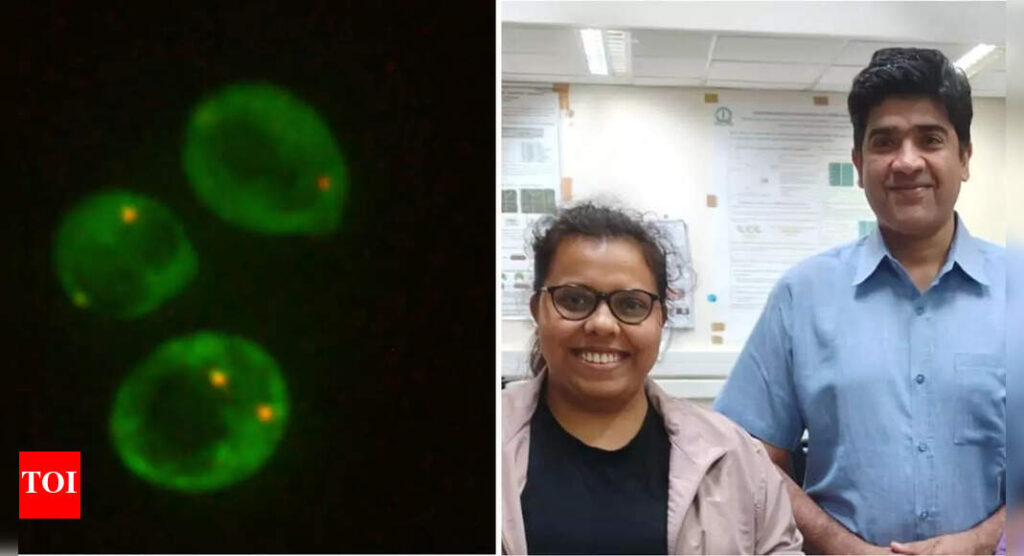
Riya Dhage (first author) and Purusharth I Rajyaguru (corresponding author) (Photo: IISc)

BENGALURU: The baker’s yeast that helps make bread and beer may also hold secrets to life beyond Earth. A new study by researchers at the Indian Institute of Science (IISc) and Isro’s Physical Research Laboratory (PRL) suggests that the humble yeast can endure conditions similar to those found on Mars.The team exposed Saccharomyces cerevisiae – the common baker’s yeast – to high-intensity shock waves and perchlorate salts, both of which mimic the hostile Martian environment. Using a High-Intensity Shock Tube for Astrochemistry (HISTA) in Bhalamurugan Sivaraman’s lab at PRL, the scientists generated shock waves reaching Mach 5.6, comparable to those produced by meteorite impacts on Mars. The yeast cells were also treated with sodium perchlorate, a toxic salt present in Martian soil.“One of the biggest hurdles was setting up the HISTA tube to expose live yeast cells to shock waves – something that has not been attempted before – and then recovering yeast with minimum contamination,” said Riya Dhage, lead author of the study and a project assistant in the lab of Purusharth I Rajyaguru, associate professor in IISc’s Department of Biochemistry.Despite the extreme treatment, the yeast survived, though its growth slowed down. The researchers found that the organism’s resilience came from its ability to form tiny, membrane-less structures called ribonucleoprotein (RNP) condensates, which protect and reorganise genetic material during stress. Cells that failed to form these structures were far less likely to survive.“What makes this work unique is the integration of shock wave physics and chemical biology with molecular cell biology to probe how life might cope with such Mars-like stressors,” Dhage said.Rajyaguru added that the study could help India’s growing astrobiology efforts. “We were surprised to observe yeast surviving the Mars-like stress conditions that we used in our experiments. We hope that this study will galvanise efforts to have yeast on board in future space explorations,” he said.The findings not only shed light on how life might adapt to extraterrestrial environments but also on designing stress-resilient biological systems for space missions.—-


Source link

Most Popular Articles