


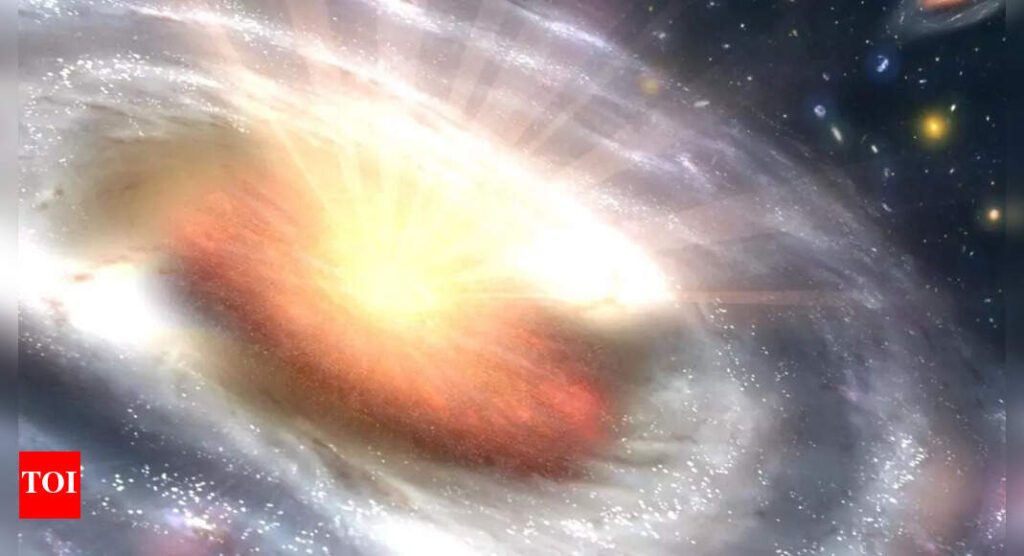
For decades, scientists believed the universe would expand forever, driven endlessly outward by a mysterious force known as dark energy. But a new study has upended that view with a provocative idea: the cosmos may one day stop expanding and instead collapse in on itself in a cataclysmic event called the “Big Crunch.” According to the research, which is currently in preprint and awaiting peer review, this reversal could happen in about 20 billion years. Based on new models and fresh astronomical data, scientists are rethinking the fate of everything we know.
The universe may not expand forever
The traditional model of the universe’s fate was built on the assumption that dark energy is constant and positive, a force pushing galaxies apart faster over time. But researchers analysing data from the Dark Energy Survey (DES) and the Dark Energy Spectroscopic Instrument (DESI) found evidence that dark energy might not be constant after all. Instead, it could vary over time, as proposed by a new theoretical framework called the axion-dark energy (aDE) model.One of the most striking findings in the new study is the possibility that the cosmological constant — which reflects the energy density of space itself — may be negative. If true, this would mean that gravity could eventually overpower expansion. Over time, this shift would cause the universe’s growth to slow, stop, and then reverse into a contraction phase.
What is the Big Crunch
If contraction occurs, all matter and energy could eventually be compressed into a single, dense point — an event known as the Big Crunch. This would be the reverse of the Big Bang. According to the aDE model, the total lifespan of the universe would be about 33.3 billion years, and we are already 13.8 billion years into that span. That leaves approximately 20 billion years before the predicted collapse.
Not a final verdict yet
Although the findings are significant, scientists caution that this new model is not confirmed. It is based on observational trends and evolving theoretical physics. Further investigation using next-generation telescopes and deeper space surveys will be needed to determine whether dark energy truly changes over time and whether a cosmic collapse is on the horizon.
Is the end really the end
Even if the Big Crunch occurs, it might not mark the permanent end of everything. Some theories propose that a collapsing universe could eventually lead to a rebirth — a new Big Bang triggering a fresh universe cycle. While these ideas remain speculative, the study has opened a bold new chapter in understanding how — and when — our universe might end.


