
Related News

While Thomas Edison’s cylinders were the first to play recorded sound, they were impractical – leading Emile Berliner to come up with a better way to play music: The gramophone,

Elon Musk’s SpaceX to launch Falcon 9 on February 2 from Vandenberg SpaceX is preparing to launch a Falcon 9 rocket carrying 25 Starlink satellites to low Earth orbit from

The Sun turns, but not in the way a solid object would. It has no hard surface, no fixed edge to follow. What scientists describe as solar rotation comes from

A coconut may seem like a simple tropical fruit, but it is actually a well-designed natural packaging. You will be surprised to know that the water inside a coconut is

NASA delays Artemis II wet dress rehearsal due to bad weather (IANS) NASA has delayed a key prelaunch test for its Artemis II mission after bad weather affected conditions at

Bright white rocks. Scattered across the rusty red plains of Mars. NASA’s Perseverance rover spotted them in Jezero crater which the scientists have been staring at them ever since. At

Trending News

In today’s digital age, the opportunity to make money online without any initial investment is more accessible than ever before. Whether you’re a student looking to earn some pocket money,

In today’s digital world, make money online has become a dream many want to turn into reality. Whether you’re looking for a side hustle or aiming to build a full-time

JSW Cement, the building materials arm of Sajjan Jindal-led JSW Group, has reduced the size of its upcoming initial public offering (IPO) to Rs 3,600 crore and will open the

The agricultural Gross Value Added (GVA) growth is expected to moderate to 4.5% in the first quarter of FY26, down from 5.4% in the preceding quarter, according to a report

Foreign portfolio investors (FPIs) turned net sellers in the Indian equity market in July, pulling out Rs 17,741 crore amid rising global trade tensions. According to data from NSDL, this

Avenue Capital Group-backed Asset Reconstruction Company (India) Ltd (ARCIL) has filed its draft red herring prospectus (DRHP) with markets regulator Sebi on Friday to raise funds through an initial public

Signal from aliens or a star? This strange object emits signals every 44 minutes; know the truth |

Word Count: 385 | Estimated Reading Time: 2 minutes


Signal from aliens or a star? This strange object emits signals every 44 minutes; know the truth

Astronomers identified a strange object in the Milky Way that sends out powerful bursts of radio waves and X-rays with steady timing. The source, known as ASKAP J1832 0911, repeats its signals every 44 minutes, a rhythm unlike anything commonly observed before. What makes the finding stand out is not just the regularity, but the combination of energy involved. Data were collected from NASA’s Chandra X-ray Observatory and the Square Kilometre Array Pathfinder (ASKAP) radio telescope in Australia, and were later combined by a team of astronomers.

ASKAP J1832 0911 emits radio waves and X-rays every 44 minutes

ASKAP J1832 0911 lies well inside the Milky Way, far from the Solar System but not near the galaxy’s edge. The distance places it among regions already rich with stars, gas, and remnants of earlier cosmic events. Despite this crowded background, the source stands out because of its repeated, intense flashes that cut through the surrounding noise.
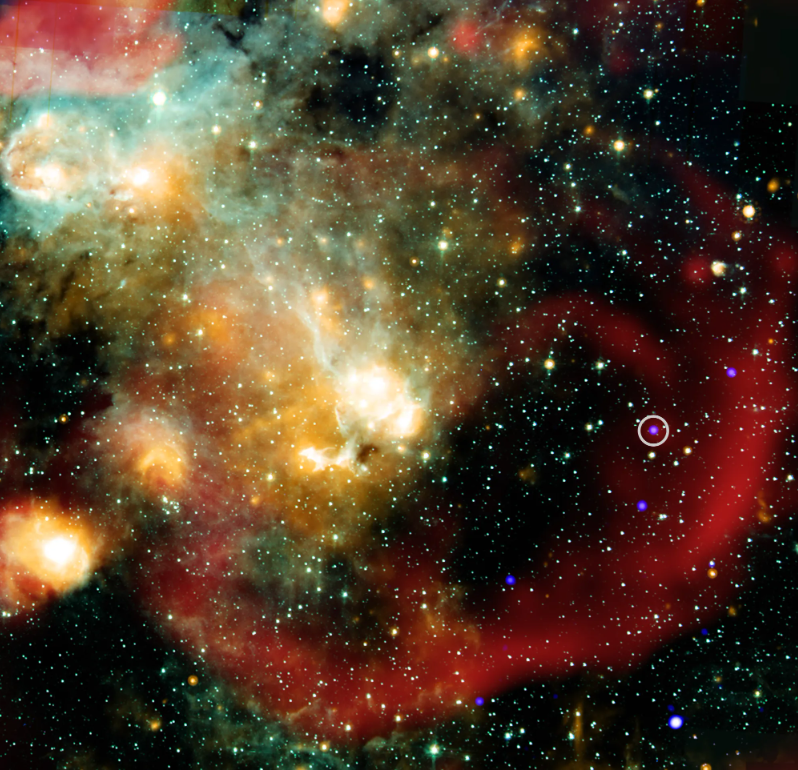
ASKAP J1832 0911 emits radio waves and X-rays every 44 minutes

ASKAP J1832 0911 emits radio waves and X-rays every 44 minutes (Image Source – NASA)

A long-period transient behaving differently

The object belongs to a rare group known as long-period radio transients. These sources were only identified a few years ago and are defined by radio pulses that repeat over tens of minutes. In contrast, pulsars can spin and pulse several times each second. ASKAP J1832 0911 fits the timing of long-period transients, but its energy output sets it apart.

X-rays appear alongside radio bursts

Using NASA’s Chandra X-ray Observatory, researchers detected X-ray emissions that rise and fall on the same 44-minute cycle as the radio signals. This pairing has not been seen before in this class of object. The link suggests a shared underlying process, though what drives it remains uncertain.

Observations combined from two major telescopes

The discovery came from combining data from the ASKAP radio telescope in Australia and the Chandra X-ray Observatory in space. Together, they provided a clearer view than either could alone. The work was led by scientists at the International Centre for Radio Astronomy Research, who say the object challenges current models.

The finding leaves more questions than answers

ASKAP J1832 0911 does not yet have a clear explanation. It may be an unusual neutron star, a magnetised remnant, or something not yet fully described. For now, it sits quietly in the galaxy, repeating its signals, offering clues without resolution.


Source link

Most Popular Articles