
Related News

For a long time, scientists believed that only amphibians like salamanders could regrow complex limbs. But then came some groundbreaking findings from Texas A&M University. Researchers there discovered that mammals

NASA’s Jet Propulsion Laboratory recently reached a significant achievement in space travel technology. They successfully tested a lithium-fed magnetoplasmadynamic (MPD) thruster, establishing a domestic power milestone for power output in

While staying at the Imperial Hotel in Tokyo during a lecture tour, Albert Einstein found himself in an awkward situation. A hotel bellboy had delivered a message to his room,

Have you ever wondered why rockets eventually tilt themselves after launch? Most people assume a rocket’s goal is to fly as high as possible, but ‘up’ is only the first

The Sombrero galaxy and its glowing halo of stars have never looked this good. The US National Science Foundation’s NOIRLab released the latest photo of the popular hat-shaped galaxy on

Researchers in China have discovered the 11th new lunar mineral, ‘Cerium–Magnesium Changesite,’ from the first Moon meteorites recovered in China. This important advancement, announced by the China Geological Survey, represents

Trending News

In today’s digital age, the opportunity to make money online without any initial investment is more accessible than ever before. Whether you’re a student looking to earn some pocket money,

In today’s digital world, make money online has become a dream many want to turn into reality. Whether you’re looking for a side hustle or aiming to build a full-time

JSW Cement, the building materials arm of Sajjan Jindal-led JSW Group, has reduced the size of its upcoming initial public offering (IPO) to Rs 3,600 crore and will open the

The agricultural Gross Value Added (GVA) growth is expected to moderate to 4.5% in the first quarter of FY26, down from 5.4% in the preceding quarter, according to a report

Foreign portfolio investors (FPIs) turned net sellers in the Indian equity market in July, pulling out Rs 17,741 crore amid rising global trade tensions. According to data from NSDL, this

Avenue Capital Group-backed Asset Reconstruction Company (India) Ltd (ARCIL) has filed its draft red herring prospectus (DRHP) with markets regulator Sebi on Friday to raise funds through an initial public

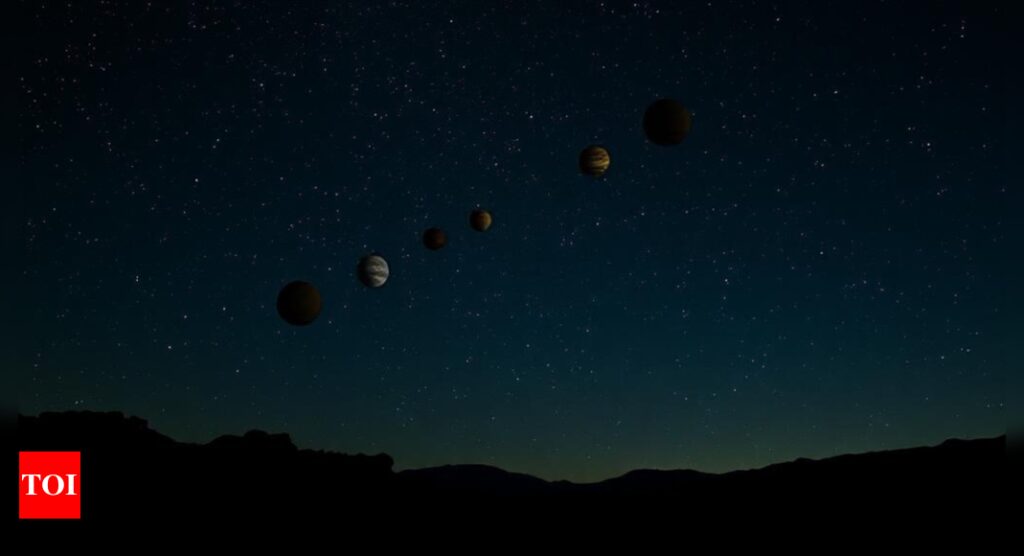
Seven planets to align tonight: How and when to watch rare planetary parade in US

Word Count: 694 | Estimated Reading Time: 4 minutes


Seven planets to align tonight: How and when to watch rare planetary parade in US

Skygazers across the United States are set to witness a rare astronomical event tonight as seven planets—Mars, Jupiter, Uranus, Venus, Neptune, Mercury, and Saturn—align in what is known as a planetary parade. This celestial phenomenon, which last occurred in January, will be visible briefly just after sunset.
According to NASA, “planet parade” isn’t a technical term in astronomy, but planetary alignments, especially those involving four or more planets, are noteworthy and infrequent. The event occurs when multiple planets appear in close proximity in the sky along the ecliptic plane, creating the illusion of a cosmic lineup.

Best time and how to watch

The planetary parade is expected to be visible just after dusk on February 28, according to Sky at Night Magazine. The best viewing conditions require a dark location with minimal light pollution and an unobstructed view of the western horizon.
NASA states that while all seven planets will technically align, not all of them will be visible to the naked eye. Mercury and Saturn, which will be positioned close to the Sun and low in the horizon, might be harder to spot. However, Venus—being the brightest—will be near the Pisces constellation, while Mars will appear reddish and high in the sky, close to Gemini.
For those hoping to catch Uranus and Neptune, a telescope will be necessary. Uranus will be located in the Aries constellation, and Neptune will be near Pisces, according to Star Walk, a skywatching app.

How long will the planetary parade be visible?

The alignment will last only a few minutes after sunset, as the planets near the horizon—Saturn and Mercury—will quickly set. Once they dip below the horizon, they will no longer be visible, but the other planets will linger in the night sky for a longer duration.

When is the next planetary parade?

Planetary alignments featuring multiple bright planets are rare. According to NASA, a similar seven-planet alignment is not expected to occur again until 2040.
Tonight’s event presents a rare opportunity for astronomy enthusiasts and casual observers alike. To maximize your chances of witnessing this celestial spectacle, head to an area with clear skies, minimal light pollution, and a broad view of the western horizon.


Source link

Most Popular Articles