
Related News

Michael Burry attends the New York premiere of “The Big Short” at the Ziegfeld Theater in New York City on Nov. 23, 2015. Jim Spellman | WireImage | Getty Images

BENGALURU: Scientists from Indian Institute of Science (IISc) reported an advance in the long quest to move electronics beyond silicon, by creating molecular-scale devices that can adapt their behaviour and

The big AI bubble question has been the tech industry’s buzziest debate all year, and one robot has weighed in with its opinion. KOID is a short but slender humanoid

On the 50th anniversary, two legends tell the story of the momentous 1969 moon walk: Apollo 11 commander Neil Armstrong and “CBS Evening News” anchor Walter Cronkite — the man

Softbank has completed its $40 billion investment commitment to OpenAI, sources told CNBC’s David Faber. The Japanese investment giant sent over a final $22 billion to $22.5 billion investment last

Some questions arrive quietly. When is the next full Moon 2026 is one of them. It usually turns up while scanning a calendar or noticing the moon hanging a little

Trending News

In today’s digital age, the opportunity to make money online without any initial investment is more accessible than ever before. Whether you’re a student looking to earn some pocket money,

In today’s digital world, make money online has become a dream many want to turn into reality. Whether you’re looking for a side hustle or aiming to build a full-time

JSW Cement, the building materials arm of Sajjan Jindal-led JSW Group, has reduced the size of its upcoming initial public offering (IPO) to Rs 3,600 crore and will open the

The agricultural Gross Value Added (GVA) growth is expected to moderate to 4.5% in the first quarter of FY26, down from 5.4% in the preceding quarter, according to a report

Foreign portfolio investors (FPIs) turned net sellers in the Indian equity market in July, pulling out Rs 17,741 crore amid rising global trade tensions. According to data from NSDL, this

Avenue Capital Group-backed Asset Reconstruction Company (India) Ltd (ARCIL) has filed its draft red herring prospectus (DRHP) with markets regulator Sebi on Friday to raise funds through an initial public

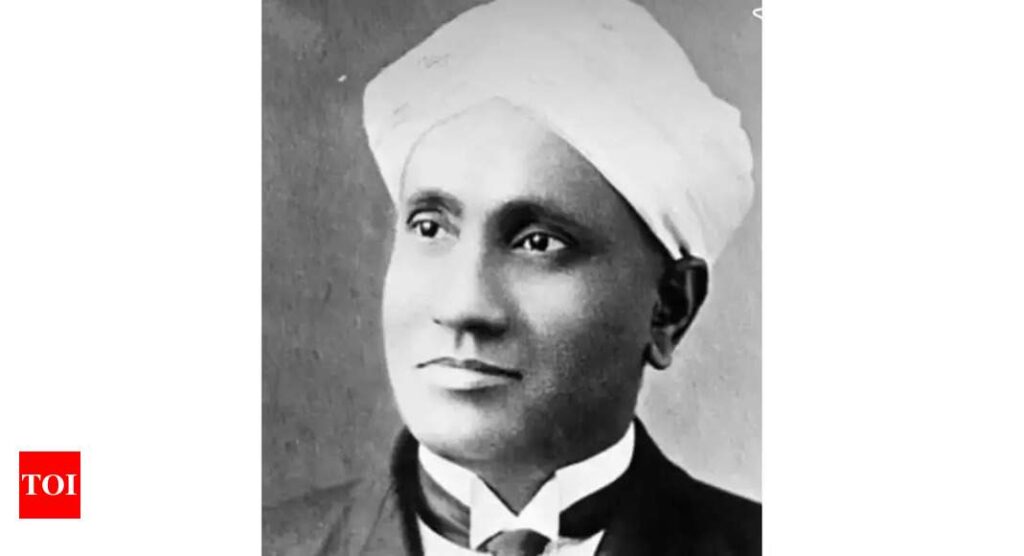
National Science Day: Celebrating the legacy of Dr CV Raman on February 28 | India News

Word Count: 667 | Estimated Reading Time: 4 minutes


National Science Day: Celebrating the legacy of Dr CV Raman on February 28

India celebrates National Science Day on February 28 each year to honor Sir CV Raman’s discovery of the Raman Effect in 1928.
This year’s theme, ‘Empowering Indian youth for global leadership in science and innovation for Viksit Bharat,’ highlights the crucial role of young minds in advancing India’s scientific and technological progress.
In 1986, the National Council for Science and Technology Communication (NCSTC) recommended that February 28 be declared National Science Day by the Government of India. Since 1987, it has been observed annually to honour the discovery of the Raman Effect and foster a scientific mindset across the nation.
Who was CV Raman

  • Chandrasekhara Venkata Raman was born on November 7, 1888, in Tiruchirappalli.
  • His father, a lecturer in mathematics and physics, provided him with an academic environment from an early age.
  • In 1902, he enrolled at Presidency College, Madras, and graduated with a BA in 1904, securing the first rank and a gold medal in physics.
  • He earned his MA degree in 1907 with highest distinction.
  • Raman’s initial research in optics and acoustics—the two fields he dedicated his career to—began during his student years.
  • At that time, pursuing a scientific career was not considered the most viable option, so in 1907, he joined the Indian Finance Department.
  • Despite his official duties, he continued experimental research at the Indian Association for the Cultivation of Science in Calcutta, where he later became Honorary Secretary in 1919.
  • In 1917, he accepted the newly endowed Palit Chair of Physics at Calcutta University.
  • After 15 years at Calcutta, he moved to the Indian Institute of Science, Bangalore, serving as a professor from 1933 to 1948. In 1948, he became the Director of the Raman Research Institute in Bangalore, which he founded and funded himself.
  • In 1926, he established the Indian Journal of Physics and served as its editor. He also played a key role in founding the Indian Academy of Sciences and became its president.
  • In 1930, Raman was awarded the Nobel Prize for his discovery of the ‘Raman effect.’
  • He was honoured with the Bharat Ratna in 1954.
  • On November 21, 1970, at the age of 82, he passed away in Bangalore.


Source link

Most Popular Articles