
Related News

Sam Altman, chief executive officer of OpenAI Inc., at the AI Impact Summit in New Delhi, India, on Thursday, Feb. 19, 2026. Prakash Singh | Bloomberg | Getty Images OpenAI

Washington — President Trump announced Friday that he is ordering all federal agencies to “immediately” stop using Anthropic’s AI technology, as the company nears a Pentagon deadline to drop its

Coreweave CEO Mike Intrator backed up the company’s massive spending plans during an interview with CNBC’s “Squawk on the Street” on Friday as shares dropped post-earnings on profitability worries. Intrator

Dell shares soared 19% on Friday after the company beat fourth-quarter estimates and issued strong guidance, as a historic memory shortage puts pressure on prices in the sector. Dell reported

The Pentagon and defense contractor Anthropic remain at an impasse over the company’s AI technology ahead of a 5:01 p.m. deadline Friday set by Defense Secretary Pete Hegseth. The CEO

Jonathan Raa | Nurphoto | Getty Images In a week where the News Gods have given us a cornucopia of stories, it’s a fool’s game to pick out the biggest

Trending News

In today’s digital age, the opportunity to make money online without any initial investment is more accessible than ever before. Whether you’re a student looking to earn some pocket money,

In today’s digital world, make money online has become a dream many want to turn into reality. Whether you’re looking for a side hustle or aiming to build a full-time

JSW Cement, the building materials arm of Sajjan Jindal-led JSW Group, has reduced the size of its upcoming initial public offering (IPO) to Rs 3,600 crore and will open the

The agricultural Gross Value Added (GVA) growth is expected to moderate to 4.5% in the first quarter of FY26, down from 5.4% in the preceding quarter, according to a report

Foreign portfolio investors (FPIs) turned net sellers in the Indian equity market in July, pulling out Rs 17,741 crore amid rising global trade tensions. According to data from NSDL, this

Avenue Capital Group-backed Asset Reconstruction Company (India) Ltd (ARCIL) has filed its draft red herring prospectus (DRHP) with markets regulator Sebi on Friday to raise funds through an initial public

NASA’s Space Umbrella Project: Earth’s magnetic field vs. solar winds |

Word Count: 370 | Estimated Reading Time: 2 minutes


NASA's Space Umbrella Project: Earth’s magnetic field vs. solar winds
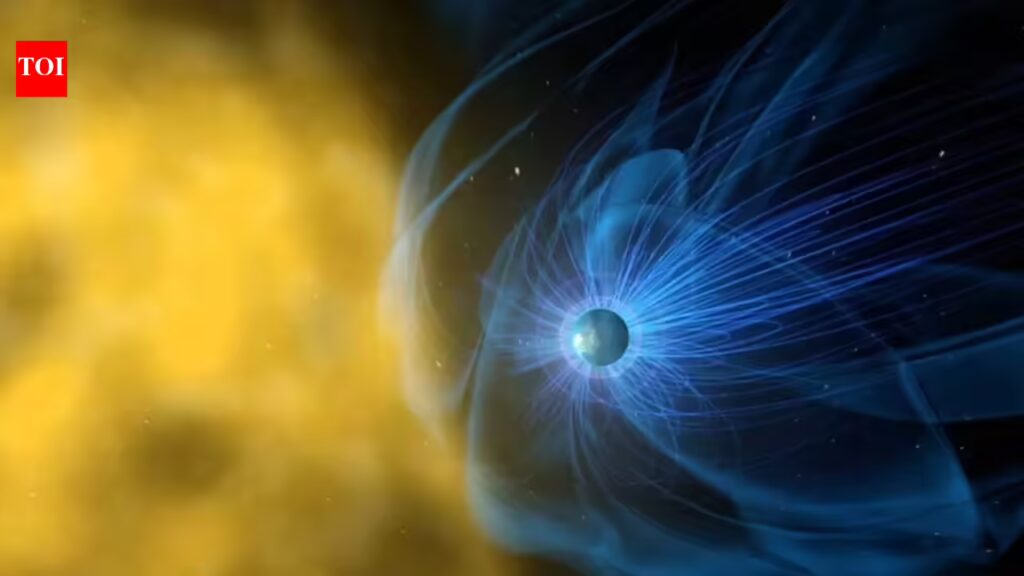
NASA’s Space Umbrella Project: Earth’s magnetic field vs. solar winds (Image source: NASA)

There is a constant outward flow of charged particles from the Sun. This flow, known as the solar wind, moves across space and reaches Earth every day. When it arrives, it meets the planet’s magnetic field, an invisible region that bends and redirects much of this energy away from the surface. The boundary between the two is active and changeable. Since 2015, NASA has been examining this area through its Magnetospheric Multiscale Mission, or MMS. The Space Umbrella project invites members of the public to review mission data and help identify moments when solar activity and Earth’s magnetosphere interact most strongly, contributing to ongoing research into solar storms and space weather.

NASA’s Space Umbrella project tracks solar wind interactions near Earth

The MMS spacecraft was launched to observe a process called magnetic reconnection. This happens when magnetic fields from the Sun and Earth briefly link, then break apart, releasing bursts of energy. The process is small in scale but significant in effect. It plays a role in shaping auroras and in driving space-weather conditions that can propagate through near-Earth space.Scientists monitor these exchanges because the released energy can disturb satellites, GPS signals and radio systems. Astronauts working beyond the thickest part of Earth’s atmosphere are also exposed to higher levels of radiation during intense solar events. The data gathered by MMS offers detailed measurements, but sorting through it takes time.

Public volunteers review Nasa data through the Space Umbrella Project

The Space Umbrella project was set up to widen that effort. Volunteers are asked to examine visual data from MMS instruments and mark periods where strong interactions appear. A short online tutorial explains how to recognise when the spacecraft is inside the magnetosphere and when it is passing through more turbulent regions influenced by the solar wind.No scientific training is required. The task is observational. Many small contributions build into a larger dataset that researchers can use to refine models of solar storms. The work does not promise dramatic discoveries. It adds pieces, slowly, to a broader understanding of how the Sun affects technology and human activity in space.


Source link

Most Popular Articles