
Related News

One of the most spectacular encounters of Hubble with a galaxy has been brought back into focus by a recent image posted on X. The image, although posted recently, is

A full moon arrives at the start of February, settling into the evening sky with little fuss but quiet interest. The event itself is familiar, yet this one carries a

Sandisk‘s stock popped 14% after the company crushed Wall Street’s fiscal second-quarter estimates, as the artificial intelligence boom sent demand for its chips skyrocketing. The flash storage memory company reported

Mesh Cube | Istock | Getty Images A new super PAC backed by AI companies raised $125 million in 2025 to further its goal of backing candidates who support national

Key Points Microsoft’s stock saw its biggest daily decline since 2020 on Thursday, falling 10%. The stock is up 0.5% premarket on Friday. The share slide wiped $357 billion off

Sam Altman, OpenAI CEO, speaks during a media tour of the Stargate data center in Abilene, Texas, on Sept. 23, 2025. Stargate is a collaboration of OpenAI, Oracle and SoftBank,

Trending News

In today’s digital age, the opportunity to make money online without any initial investment is more accessible than ever before. Whether you’re a student looking to earn some pocket money,

In today’s digital world, make money online has become a dream many want to turn into reality. Whether you’re looking for a side hustle or aiming to build a full-time

JSW Cement, the building materials arm of Sajjan Jindal-led JSW Group, has reduced the size of its upcoming initial public offering (IPO) to Rs 3,600 crore and will open the

The agricultural Gross Value Added (GVA) growth is expected to moderate to 4.5% in the first quarter of FY26, down from 5.4% in the preceding quarter, according to a report

Foreign portfolio investors (FPIs) turned net sellers in the Indian equity market in July, pulling out Rs 17,741 crore amid rising global trade tensions. According to data from NSDL, this

Avenue Capital Group-backed Asset Reconstruction Company (India) Ltd (ARCIL) has filed its draft red herring prospectus (DRHP) with markets regulator Sebi on Friday to raise funds through an initial public

NASA reveals how Arctic air froze half of America in January |

Word Count: 390 | Estimated Reading Time: 2 minutes


NASA reveals how Arctic air froze half of America in January
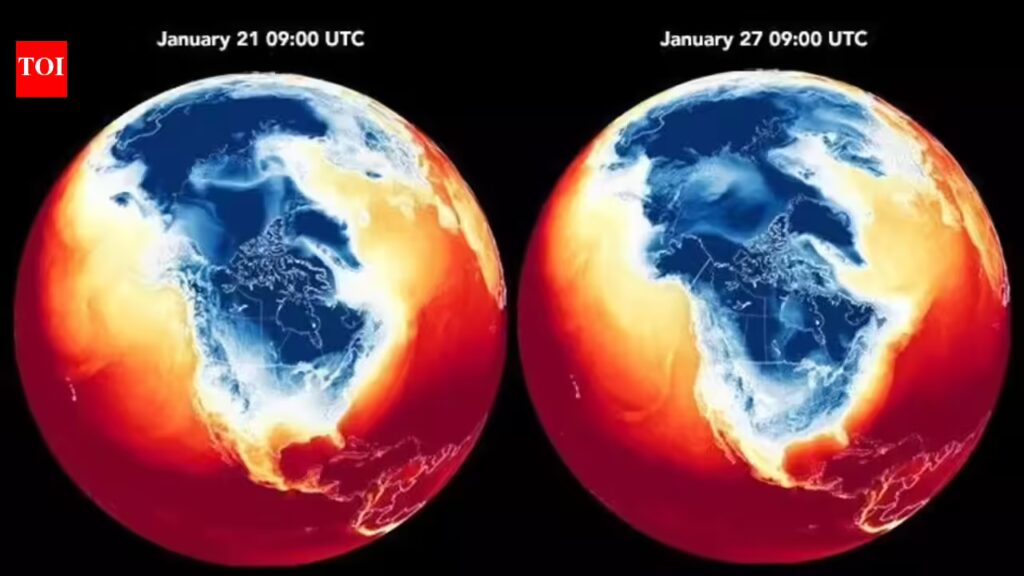
NASA reveals how Arctic air froze half of America in January (Image Source – NASA)

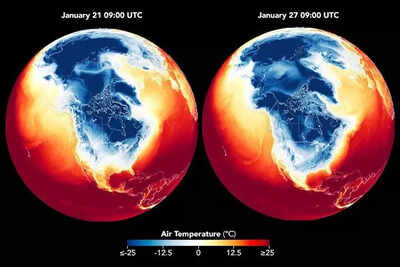
A big winter storm hit the US in late January and dumped snow and ice across a lot of states. After the storm passed, the cold didn’t leave. Instead, it stuck around for days and covered a huge area, especially places east of the Rocky Mountains.NASA has published an animation that is basically a moving map that shows how cold the air was each day. Dark blue means really cold. You can see temperatures rising a bit during the day and dropping at night, but overall the cold air spreads south and just hangs there instead of moving on.

NASA observations show arctic air spreading across the USA

Extremely cold air from northern Canada and even Siberia flowed into North America. High-pressure systems pushed the jet stream south, acting like a guide rail that dragged this freezing air deep into the US. This cold air also mixed with moist air, which is why the storm produced so much snow and ice from the Southwest all the way to New England.Some places saw record-breaking cold. In Nebraska, temperatures dropped to −26°F (−32°C). Parts of Texas, which usually don’t deal with this kind of weather, fell into the single digits. Even when temperatures started to rise slightly, the wind made it feel much colder, with wind chills as low as −20°F (−29°C) in the Midwest and Northeast.

NASA temperature maps show sustained cold

NASA tracked the event using blended from satellites and its GEOS global model. The maps show dark blue zones spreading south and east between January 21 and 29. These the coldest air near the surface. While the maps flickered with daily changes, the underlying signal remained steady. Cold air expanded, paused, and only gradually loosened its grip. The scale stood out, covering large parts of North America rather than isolated pockets.

NASA supports response and recovery efforts

NASA activated its Disasters Response Coordination System during the event. The agency provided maps and data through its open access portal to support emergency managers. These tools helped track conditions and plan response work. As forecasts pointed to further cold into early February, attention shifted to endurance rather than quick recovery. The weather eased in stages, unevenly, leaving some regions waiting longer than others.


Source link