


Related News

CEO, Bluesky Social Jay Graber speaks on stage during 2025 Fast Company’s Most Innovative Companies Summit & Gala at Jacob Javits Center on June 5, 2025 in New York City.

U.S. President Donald Trump, Secretary of Defense Pete Hegseth behind, speaks to reporters aboard Air Force One on a flight from Dover, Delaware, to Miami, Florida, U.S., March 7, 2026.

A Zoox autonomous robotaxi in San Francisco, California, US, on Wednesday, Dec. 4, 2024. David Paul Morris | Bloomberg | Getty Images Amazon‘s self-driving unit Zoox plans to start testing

AI data center startup Nscale has raised $2 billion at a $14.6 billion valuation, the company announced on Monday, as the AI infrastructure boom continues. The Series C featured Nvidia

In this web exclusive, Tim Cook, the CEO of Apple, talks with “Sunday Morning” correspondent David Pogue (author of “Apple: The First 50 Years”) to discuss the company’s first half-century

In 1971, the origin story of Apple began with the friendship of engineering prodigy Steve Wozniak and computer enthusiast Steve Jobs. The machine they built and sold five years later

Trending News

In today’s digital age, the opportunity to make money online without any initial investment is more accessible than ever before. Whether you’re a student looking to earn some pocket money,

In today’s digital world, make money online has become a dream many want to turn into reality. Whether you’re looking for a side hustle or aiming to build a full-time

JSW Cement, the building materials arm of Sajjan Jindal-led JSW Group, has reduced the size of its upcoming initial public offering (IPO) to Rs 3,600 crore and will open the

The agricultural Gross Value Added (GVA) growth is expected to moderate to 4.5% in the first quarter of FY26, down from 5.4% in the preceding quarter, according to a report

Foreign portfolio investors (FPIs) turned net sellers in the Indian equity market in July, pulling out Rs 17,741 crore amid rising global trade tensions. According to data from NSDL, this

Avenue Capital Group-backed Asset Reconstruction Company (India) Ltd (ARCIL) has filed its draft red herring prospectus (DRHP) with markets regulator Sebi on Friday to raise funds through an initial public

‘Job security, flexibility top priorities for Indians’

Word Count: 664 | Estimated Reading Time: 4 minutes


'Job security, flexibility top priorities for Indians'

NEW DELHI: Traditional incentives like salary seem to have become less significant this year for Indian employees as workplace flexibility, job security, opportunities for learning and development and sense of belonging take centre stage, according to talent firm Randstad.
Last year, employees prioritised work-life balance, followed by remuneration and job security. According to Randstad India’s Workmonitor 2025 survey, 52 per cent of the Indian workforce would leave a job if it lacked sufficient flexibility, compared to 31 per cent globally. Flexibility continues to be a key decision-making factor, with 60 per cent of employees rejecting a job without flexible working hours and 56 per cent declining roles lacking flexibility in work locations, the survey added.
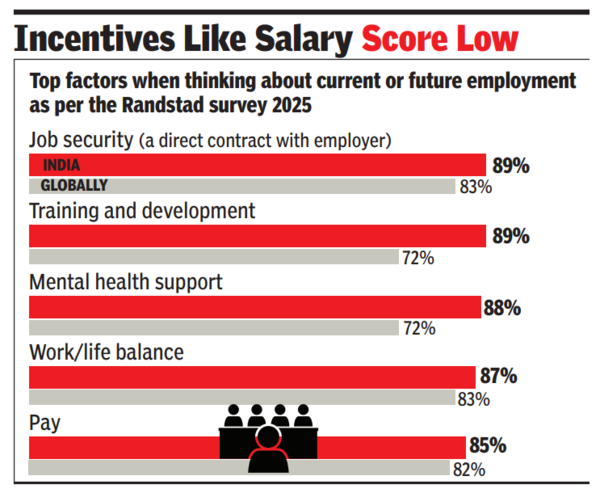
Incentives like salary score low

The findings indicate that employees are increasingly prioritising work that resonates with their personal values and life goals, moving beyond financial incentives. Job security, mental health support, and work-life balance now hold more significance. In fact, pay has dropped to the fourth spot, reflecting a shift toward a more holistic view of employment.
Further, the demand for flexible working hours is significantly higher across all generations in India compared to the global average due to unique socio-economic and workplace dynamics.
Viswanath PS, MD & CEO, Randstad India, said, “The generational divide in Indian workplace expectations is narrowing, and the data is clear – flexibility is no longer a benefit; it’s a baseline expectation across all age groups. Whether it’s Gen Z entering the workforce, millennials balancing career growth with personal commitments or Gen X in leadership roles, everyone values the ability to work on their own terms. This shift signals a fundamental change for organizations – flexibility must be embedded into work design, not treated as a perk. Equally, the demand for continuous learning highlights that talent isn’t just looking for jobs – they are looking for careers that evolve with them.”
Gen Z (62 per cent vs 45 per cent globally) received flexible working hours as they enter a digital-first job market where long commutes, cultural expectations around family involvement and high job competition make work-life balance essential.


Source link

Most Popular Articles