

Related News

Have you ever wondered why rockets eventually tilt themselves after launch? Most people assume a rocket’s goal is to fly as high as possible, but ‘up’ is only the first

The Sombrero galaxy and its glowing halo of stars have never looked this good. The US National Science Foundation’s NOIRLab released the latest photo of the popular hat-shaped galaxy on

Researchers in China have discovered the 11th new lunar mineral, ‘Cerium–Magnesium Changesite,’ from the first Moon meteorites recovered in China. This important advancement, announced by the China Geological Survey, represents

China’s space mission (AP image) China has selected two Pakistani astronauts as candidates for its space programme, according to the state’s Manned Space Agency.In a statement issued on Wednesday, the

Challenge to Elon Musk’s SpaceX: Jeff Bezos’ Blue Origin to attempt first reused booster launch of New Glenn rocket Blue Origin, the US space company founded by Jeff Bezos, is

MUMBAI: Three days after the successful splashdown of Artemis-2, the Trump administration on Tuesday issued a memorandum which among other things includes safely deploying nuclear reactors in space orbit as

Trending News

In today’s digital age, the opportunity to make money online without any initial investment is more accessible than ever before. Whether you’re a student looking to earn some pocket money,

In today’s digital world, make money online has become a dream many want to turn into reality. Whether you’re looking for a side hustle or aiming to build a full-time

JSW Cement, the building materials arm of Sajjan Jindal-led JSW Group, has reduced the size of its upcoming initial public offering (IPO) to Rs 3,600 crore and will open the

The agricultural Gross Value Added (GVA) growth is expected to moderate to 4.5% in the first quarter of FY26, down from 5.4% in the preceding quarter, according to a report

Foreign portfolio investors (FPIs) turned net sellers in the Indian equity market in July, pulling out Rs 17,741 crore amid rising global trade tensions. According to data from NSDL, this

Avenue Capital Group-backed Asset Reconstruction Company (India) Ltd (ARCIL) has filed its draft red herring prospectus (DRHP) with markets regulator Sebi on Friday to raise funds through an initial public

How did Mars lose so much of its water? Rare dust storms may hold the answer |

Word Count: 318 | Estimated Reading Time: 2 minutes


How did Mars lose so much of its water? Rare dust storms may hold the answer

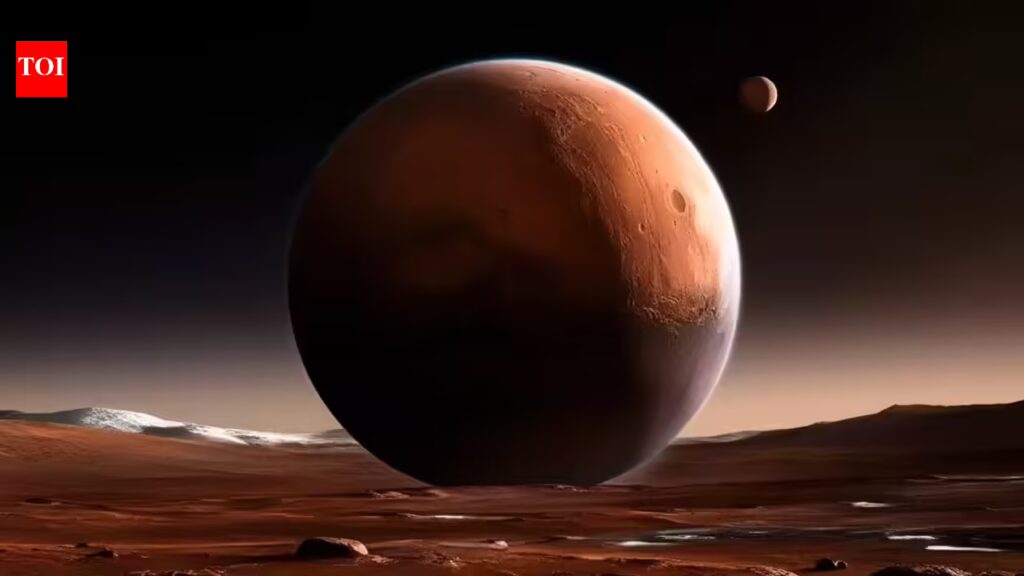
Mars, the Red Planet, seems to have had rivers, lakes, maybe even seas. Minerals, channels, and rock formations all hint at water once flowing freely. Scientists have long wondered what happened. Recently, researchers reported a rare dust storm might have played a role not just any storm, as cited in the study published by the Royal Belgian Institute for Space Aeronomy titled ‘An unusual dust storm on Mars reveals how the Red Planet lost some of its water’. The study hints that the intense events might have helped Mars lose water over time, to understand the planet’s mysterious history, which hints at how Mars might have lost water.

How dust storms change the game of Mars

Most Martian summers in the northern hemisphere are quiet. Water usually stays low in the atmosphere. Southern summers are different. Mars’ orbit is elliptical, so the south gets hotter. Dust lifts, air heats, water rises, hydrogen escapes. But this time, in Martian Year 37 (2022–2023), something unusual happened. A dust storm appeared in the northern hemisphere. It triggered water to surge upwards to 60–80 kilometres which is approximately 10 times higher than normal. Observers reportedly couldn’t recall anything like it in almost twenty years.

Rare Mars dust storm reveals new clues about how the planet lost its water

The storm caused water to spread rapidly around the planet. Weeks later, dust settled. Water dropped back down. But not before hydrogen escaped in higher amounts. Experts estimate the escape jumped 2.5 times compared to normal northern summer levels.Over time, Mars lost water enough to cover hundreds of metres across the planet. These findings give new insight into a piece of that story. They also hint at how unpredictable Mars’ climate might be. Short-term, intense events are apparently significant.Observers reportedly watched hydrogen increase in the uppermost layers too. For scientists, it was a rare opportunity. To see Mars changing in real time.


Source link

Most Popular Articles