
Related News

Have you ever wondered why rockets eventually tilt themselves after launch? Most people assume a rocket’s goal is to fly as high as possible, but ‘up’ is only the first

The Sombrero galaxy and its glowing halo of stars have never looked this good. The US National Science Foundation’s NOIRLab released the latest photo of the popular hat-shaped galaxy on

Researchers in China have discovered the 11th new lunar mineral, ‘Cerium–Magnesium Changesite,’ from the first Moon meteorites recovered in China. This important advancement, announced by the China Geological Survey, represents

China’s space mission (AP image) China has selected two Pakistani astronauts as candidates for its space programme, according to the state’s Manned Space Agency.In a statement issued on Wednesday, the

Challenge to Elon Musk’s SpaceX: Jeff Bezos’ Blue Origin to attempt first reused booster launch of New Glenn rocket Blue Origin, the US space company founded by Jeff Bezos, is

MUMBAI: Three days after the successful splashdown of Artemis-2, the Trump administration on Tuesday issued a memorandum which among other things includes safely deploying nuclear reactors in space orbit as

Trending News

In today’s digital age, the opportunity to make money online without any initial investment is more accessible than ever before. Whether you’re a student looking to earn some pocket money,

In today’s digital world, make money online has become a dream many want to turn into reality. Whether you’re looking for a side hustle or aiming to build a full-time

JSW Cement, the building materials arm of Sajjan Jindal-led JSW Group, has reduced the size of its upcoming initial public offering (IPO) to Rs 3,600 crore and will open the

The agricultural Gross Value Added (GVA) growth is expected to moderate to 4.5% in the first quarter of FY26, down from 5.4% in the preceding quarter, according to a report

Foreign portfolio investors (FPIs) turned net sellers in the Indian equity market in July, pulling out Rs 17,741 crore amid rising global trade tensions. According to data from NSDL, this

Avenue Capital Group-backed Asset Reconstruction Company (India) Ltd (ARCIL) has filed its draft red herring prospectus (DRHP) with markets regulator Sebi on Friday to raise funds through an initial public

From dye to detector: Scientists turn herbal extract into milk freshness sensor

Word Count: 736 | Estimated Reading Time: 4 minutes


From dye to detector: Scientists turn herbal extract into milk freshness sensor
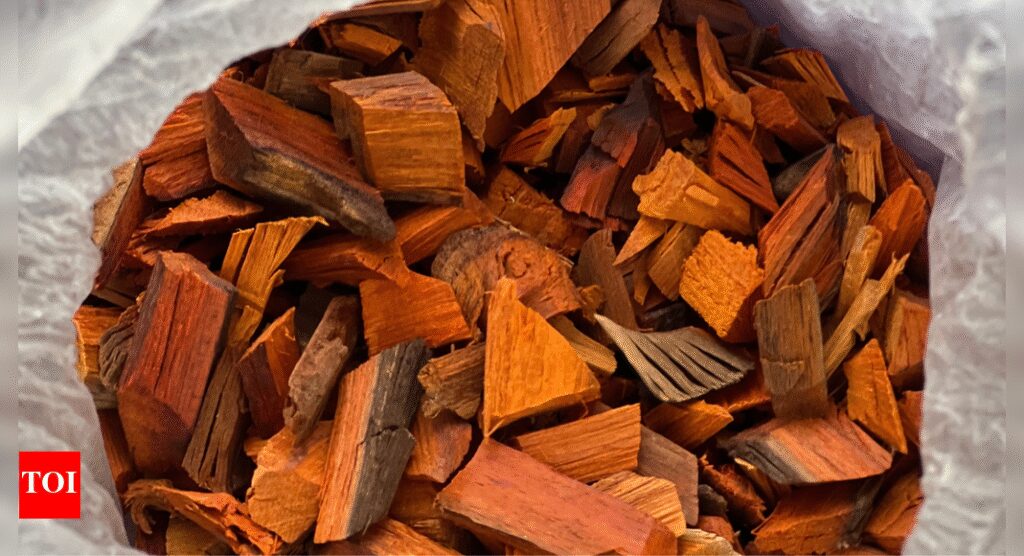
Photograph of sappan heartwood used for the study

BENGALURU: A team of chemists at Christ University has turned a traditional Asian dye wood into a scientific tool to tackle one of the most persistent problems in food safety—detecting when milk begins to spoil.Using extracts from Caesalpinia sappan L., or sappan heartwood, the researchers have developed a natural, plant-based colour indicator that changes hue as milk loses freshness.Researchers say that the indicator could be integrated into intelligent packaging that alerts consumers when milk or other perishables begin to spoil. Such real-time monitoring, they say, could help reduce waste and prevent unsafe consumption.With India producing more than 239 million tonnes of milk annually—one-fourth of the world’s total—spoilage remains a major issue, especially in areas with poor refrigeration.

Natural freshness sensor

The work, combining traditional plant wisdom with modern chemistry, was recently published in the journal Food Analytical Methods (Springer Nature) and is also the subject of an Indian patent application.The study was led by Vinod TP, associate professor at Christ University’s department of chemistry, and carried out by doctoral scholars Simran Nagpal and Chaithra KP, with Sreelekha S from Tagore Memorial Higher Secondary School, Kannur, contributing to ideation.The indicator solution, made by boiling sappan heartwood in water, responds sharply to pH changes—the key chemical signal of milk spoilage. Fresh milk keeps the solution a bright orange-red; as acidity builds, it turns orange and finally yellow.These colour shifts correspond to the pH dropping from about 7.0 in fresh milk to 3.5 in spoiled samples.The active compound behind the transformation is brazilein, a natural pigment in sappan heartwood known for its medicinal and dyeing properties. Its stability under light and heat makes it ideal for real-world use.

Easy to check

To make the test accessible, the team showed that colour changes could be captured and analysed using a smartphone camera. Digital images were processed through RGB (red, green, blue) analysis, with the “green chromatic shift” serving as a reliable measure of freshness.“This approach eliminates the need for laboratory tools or trained personnel. Anyone can check the milk’s condition visually or with a smartphone app,” Vinod told TOI.By fusing traditional plant chemistry with digital tools, the Christ University team has demonstrated a sustainable innovation that turns colour into a language of food safety.


Source link

Most Popular Articles