
Related News

The Sombrero galaxy and its glowing halo of stars have never looked this good. The US National Science Foundation’s NOIRLab released the latest photo of the popular hat-shaped galaxy on

Researchers in China have discovered the 11th new lunar mineral, ‘Cerium–Magnesium Changesite,’ from the first Moon meteorites recovered in China. This important advancement, announced by the China Geological Survey, represents

China’s space mission (AP image) China has selected two Pakistani astronauts as candidates for its space programme, according to the state’s Manned Space Agency.In a statement issued on Wednesday, the

Challenge to Elon Musk’s SpaceX: Jeff Bezos’ Blue Origin to attempt first reused booster launch of New Glenn rocket Blue Origin, the US space company founded by Jeff Bezos, is

MUMBAI: Three days after the successful splashdown of Artemis-2, the Trump administration on Tuesday issued a memorandum which among other things includes safely deploying nuclear reactors in space orbit as

BENGALURU: In the vast hierarchy of the universe, the smallest galaxies are often overlooked. But a new study now suggests they may hold clues to one of astronomy’s most persistent

Trending News

In today’s digital age, the opportunity to make money online without any initial investment is more accessible than ever before. Whether you’re a student looking to earn some pocket money,

In today’s digital world, make money online has become a dream many want to turn into reality. Whether you’re looking for a side hustle or aiming to build a full-time

JSW Cement, the building materials arm of Sajjan Jindal-led JSW Group, has reduced the size of its upcoming initial public offering (IPO) to Rs 3,600 crore and will open the

The agricultural Gross Value Added (GVA) growth is expected to moderate to 4.5% in the first quarter of FY26, down from 5.4% in the preceding quarter, according to a report

Foreign portfolio investors (FPIs) turned net sellers in the Indian equity market in July, pulling out Rs 17,741 crore amid rising global trade tensions. According to data from NSDL, this

Avenue Capital Group-backed Asset Reconstruction Company (India) Ltd (ARCIL) has filed its draft red herring prospectus (DRHP) with markets regulator Sebi on Friday to raise funds through an initial public

‘Cosmic Creepy-Crawly’: Nasa unveils new Red Spider Nebula image; reveals new details

Word Count: 703 | Estimated Reading Time: 4 minutes


‘Cosmic Creepy-Crawly’: Nasa unveils new Red Spider Nebula image; reveals new details

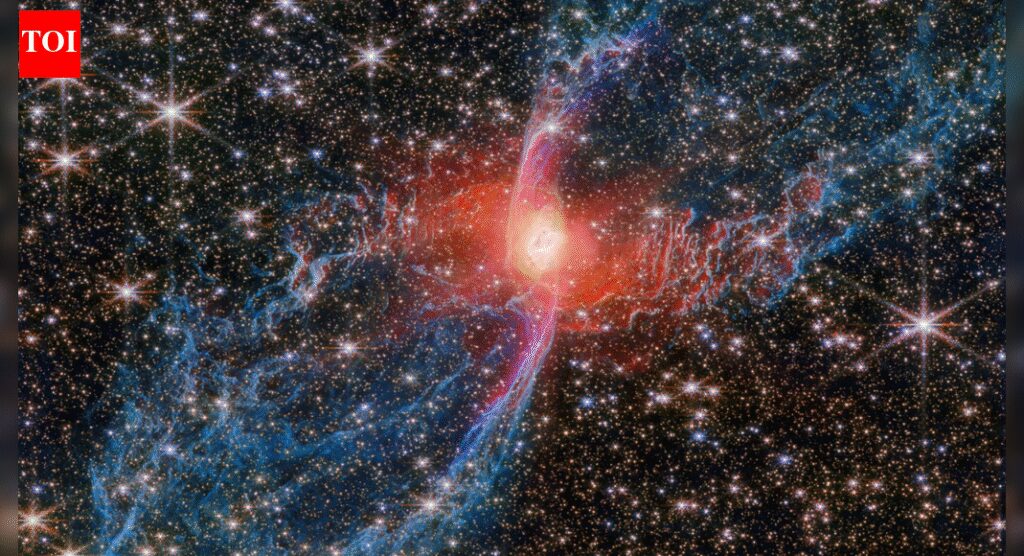
Red Spider Nebula (Image credits: Nasa)

Nasa has released a new image of the Red Spider Nebula, revealing never-before-seen details of NGC 6537. Captured with the James Webb Space Telescope’s Near-InfraRed Camera (NIRCam), the image shows the nebula with remarkable clarity, its full structure stretched across a dense backdrop of thousands of stars. The European Space Agency (ESA) described the picture of the month as a “cosmic creepy crawly.”Planetary nebulae like the Red Spider form when Sun-like stars reach the ends of their lives, shed their outer layers, and expose their hot cores. Ultraviolet radiation from these cores ionises the surrounding gas, causing it to glow for a relatively brief period — only a few tens of thousands of years.A key highlight in Webb’s new view is the nebula’s central star. In older optical images from telescopes such as Hubble, it appears faint and blue. With Webb’s infrared sensitivity, however, it shows up as red, revealing a surrounding shroud of hot dust. Nasa notes that this dust likely forms a disc around the star. Although only one star is visible, researchers believe a hidden companion may also be present, which could help explain the nebula’s narrow waist and wide outflows.Webb’s data also expose, for the first time, the full reach of the nebula’s dramatic lobes — the “legs” of the spider. These lobes, traced in blue by light from H₂ molecules, form closed, bubble-like shells that extend roughly three light-years from end to end. They have expanded over thousands of years as gas has steadily flowed out from the nebula’s centre.Closer to the core, the telescope reveals signs of ongoing activity. An elongated purple “S” shape marks the path of a fast-moving jet that has slammed into older material, helping carve the rippling structure that defines the nebula today.The observations come from Webb GO programme #4571 (PI: J. Kastner), which aims to understand how jets and outflows from central stars shape bipolar planetary nebulae. According to Nasa, NIRCam’s advanced near-infrared capabilities made it possible to uncover these newly revealed structures in the image released on October. 26, 2025.


Source link

Most Popular Articles