
Related News

The Sombrero galaxy and its glowing halo of stars have never looked this good. The US National Science Foundation’s NOIRLab released the latest photo of the popular hat-shaped galaxy on

Researchers in China have discovered the 11th new lunar mineral, ‘Cerium–Magnesium Changesite,’ from the first Moon meteorites recovered in China. This important advancement, announced by the China Geological Survey, represents

China’s space mission (AP image) China has selected two Pakistani astronauts as candidates for its space programme, according to the state’s Manned Space Agency.In a statement issued on Wednesday, the

Challenge to Elon Musk’s SpaceX: Jeff Bezos’ Blue Origin to attempt first reused booster launch of New Glenn rocket Blue Origin, the US space company founded by Jeff Bezos, is

MUMBAI: Three days after the successful splashdown of Artemis-2, the Trump administration on Tuesday issued a memorandum which among other things includes safely deploying nuclear reactors in space orbit as

BENGALURU: In the vast hierarchy of the universe, the smallest galaxies are often overlooked. But a new study now suggests they may hold clues to one of astronomy’s most persistent

Trending News

In today’s digital age, the opportunity to make money online without any initial investment is more accessible than ever before. Whether you’re a student looking to earn some pocket money,

In today’s digital world, make money online has become a dream many want to turn into reality. Whether you’re looking for a side hustle or aiming to build a full-time

JSW Cement, the building materials arm of Sajjan Jindal-led JSW Group, has reduced the size of its upcoming initial public offering (IPO) to Rs 3,600 crore and will open the

The agricultural Gross Value Added (GVA) growth is expected to moderate to 4.5% in the first quarter of FY26, down from 5.4% in the preceding quarter, according to a report

Foreign portfolio investors (FPIs) turned net sellers in the Indian equity market in July, pulling out Rs 17,741 crore amid rising global trade tensions. According to data from NSDL, this

Avenue Capital Group-backed Asset Reconstruction Company (India) Ltd (ARCIL) has filed its draft red herring prospectus (DRHP) with markets regulator Sebi on Friday to raise funds through an initial public

Comet C/2025 K1 ATLAS breaking apart into pieces: Gemini North Telescope release images after a closest Sun flyby |

Word Count: 331 | Estimated Reading Time: 2 minutes


Comet C/2025 K1 ATLAS breaking apart into pieces: Gemini North Telescope release images after a closest Sun flyby

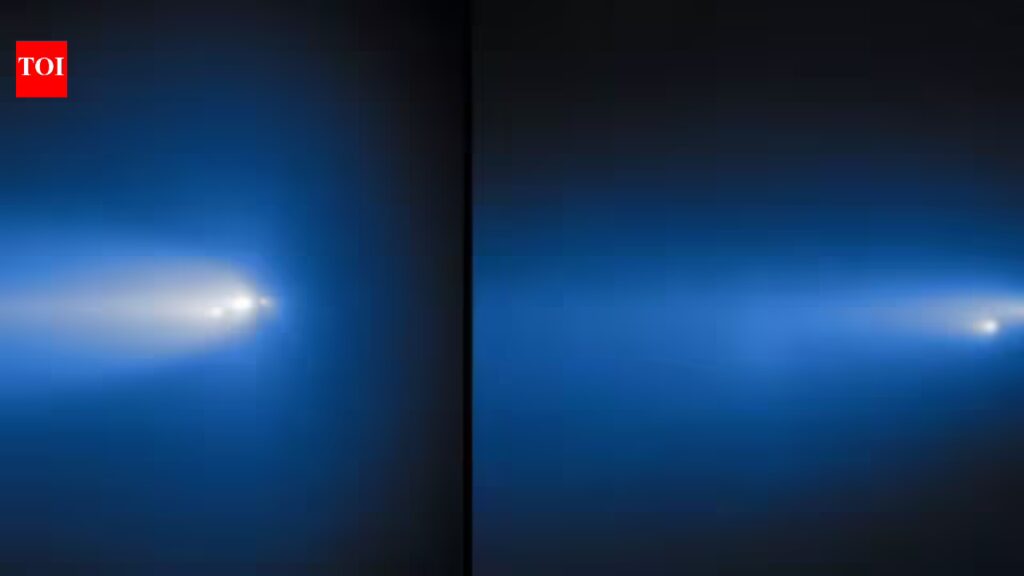
Comet C/2025 K1 ATLAS, a relatively new visitor from the outer solar system, has broken apart after swooping close to the Sun in October 2025. Stunning images captured by the Gemini North telescope in Hawaii show glowing fragments tumbling through space, like shards of icy glass, which observers say is a rare sight. These long-period comets are loosely bound collections of ice and dust, so they’re fragile. They might look solid in pictures, but they can crumble with just a little push from the Sun’s gravity or the solar wind.

Comet C/2025 K1 ATLAS captured breaking apart in new telescope images revealed

As reported in NOIRLab, the new image released on 29 January, falling apart in the pictures obtained: with one set from November 11, 2025, shows a glowing white streak with hints of blue, streaking across the dark sky. By December 6, the comet had further fragmented. Experts say these pictures are rare because most comets aren’t observed in such detail when they break up. High up on Mauna Kea, the Gemini North telescope reportedly captured the comet in all its messy glory. It’s a big telescope with 8.1 meters across at the International Gemini Observatory. C/2025 K1 (ATLAS) made its closest approach on October 8. The Sun’s gravity and the solar wind apparently worked together to rip the comet into pieces. Astronomers saw at least three chunks, maybe a fourth with distances of up to 2,000 kilometres reportedly separated some pieces.

Gianluca Masi and Asiago Observatory catch the comet splitting

Gianluca Masi in Italy caught it too, using a smaller telescope; he apparently saw three or four fragments. The Asiago Observatory also spotted two main pieces separated by roughly 1,200 miles. It’s like watching cosmic fireworks, but frozen in time. C/2025 K1 (ATLAS) isn’t from around here. It was discovered in May 2025 by the Asteroid Terrestrial-impact Last Alert System. Billions of comets might float out there, dormant for eons, until a gravitational nudge sends one falling toward the Sun.


Source link

Most Popular Articles