
Related News

The big AI bubble question has been the tech industry’s buzziest debate all year, and one robot has weighed in with its opinion. KOID is a short but slender humanoid

On the 50th anniversary, two legends tell the story of the momentous 1969 moon walk: Apollo 11 commander Neil Armstrong and “CBS Evening News” anchor Walter Cronkite — the man

Softbank has completed its $40 billion investment commitment to OpenAI, sources told CNBC’s David Faber. The Japanese investment giant sent over a final $22 billion to $22.5 billion investment last

Some questions arrive quietly. When is the next full Moon 2026 is one of them. It usually turns up while scanning a calendar or noticing the moon hanging a little

The logo of Japanese company SoftBank Group at the company’s headquarters in Tokyo on November 21, 2025. Kazuhiro Nogi | Afp | Getty Images Shares of data center investment firm

1 Ship to breach Earth’s CRUST Next year, a 600-foot Chinese research vessel will set sail to find the perfect site from where it will start drilling down to the

Trending News

In today’s digital age, the opportunity to make money online without any initial investment is more accessible than ever before. Whether you’re a student looking to earn some pocket money,

In today’s digital world, make money online has become a dream many want to turn into reality. Whether you’re looking for a side hustle or aiming to build a full-time

JSW Cement, the building materials arm of Sajjan Jindal-led JSW Group, has reduced the size of its upcoming initial public offering (IPO) to Rs 3,600 crore and will open the

The agricultural Gross Value Added (GVA) growth is expected to moderate to 4.5% in the first quarter of FY26, down from 5.4% in the preceding quarter, according to a report

Foreign portfolio investors (FPIs) turned net sellers in the Indian equity market in July, pulling out Rs 17,741 crore amid rising global trade tensions. According to data from NSDL, this

Avenue Capital Group-backed Asset Reconstruction Company (India) Ltd (ARCIL) has filed its draft red herring prospectus (DRHP) with markets regulator Sebi on Friday to raise funds through an initial public

Black holes and cosmic jets join forces to shape galaxies | India News

Word Count: 703 | Estimated Reading Time: 4 minutes


Black holes and cosmic jets join forces to shape galaxies

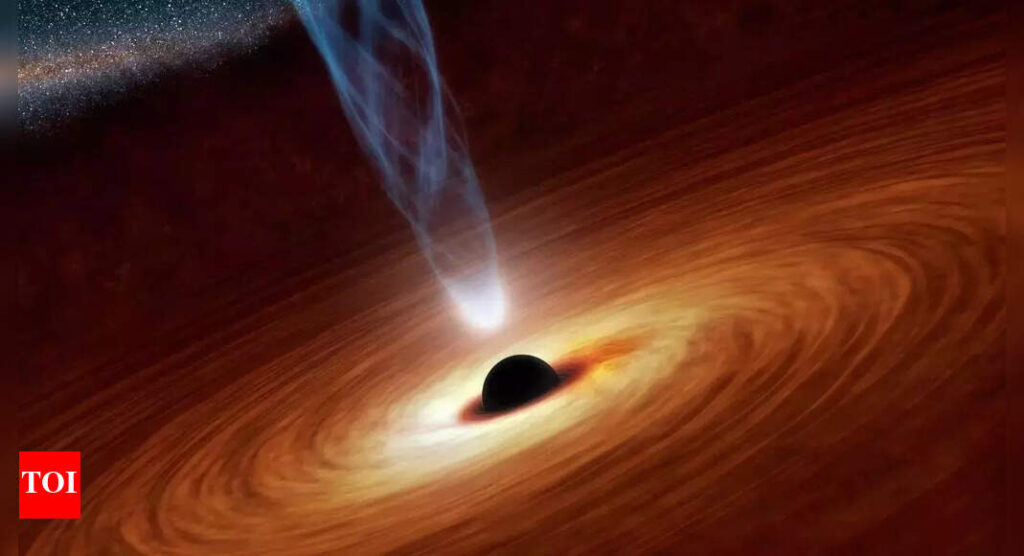
BENGALURU: A new study led by astronomers from the Indian Institute of Astrophysics (IIA) has revealed how supermassive black holes and the powerful jets they emit can work together to regulate the growth of galaxies by suppressing star formation.The study, published in The Astrophysical Journal, shows that both radiation from the surroundings of black holes and high-speed jets can eject gas from the central regions of galaxies. This loss of gas prevents new stars from forming, explaining why some galaxies have very low star-formation rates.Using data from the Sloan Digital Sky Survey (SDSS) and the Very Large Array (VLA) in the United States, researchers examined more than 500 nearby galaxies hosting active galactic nuclei (AGN)—energetic galactic centres powered by material falling into supermassive black holes.“We found that outflows of warm ionised gas are widespread in AGN, and while radiation from the black hole is the main driver, galaxies with radio jets show significantly faster and more energetic outflows,” Payel Nandi, a PhD student at IIA and the study’s lead author, said.The team found that gas outflows are more than twice as common in galaxies detected at radio wavelengths (56%) compared to those without radio emission (25%). These outflows can reach speeds of up to 2,000 kilometres per second, fast enough to escape the galaxy’s gravitational pull.CS Stalin, a faculty member at IIA and co-author, said the study highlights the importance of combining multi-wavelength data to understand the full picture of galaxy evolution. The researchers also observed a strong link between the power of these outflows and the total luminosity of the supermassive black holes. In galaxies with radio jets, this link is even stronger, suggesting that jets act as “boosters” that enhance the black hole’s ability to eject gas.The results support the idea of “negative AGN feedback”, where black hole activity suppresses star formation by blowing away the very gas needed to create new stars.“This study is a step forward in understanding the complex links between supermassive black holes, jets, star formation and galaxy evolution,” Dhruba J Saikia, co-author from the Inter-University Centre for Astronomy and Astrophysics (IUCAA), said.


Source link

Most Popular Articles