


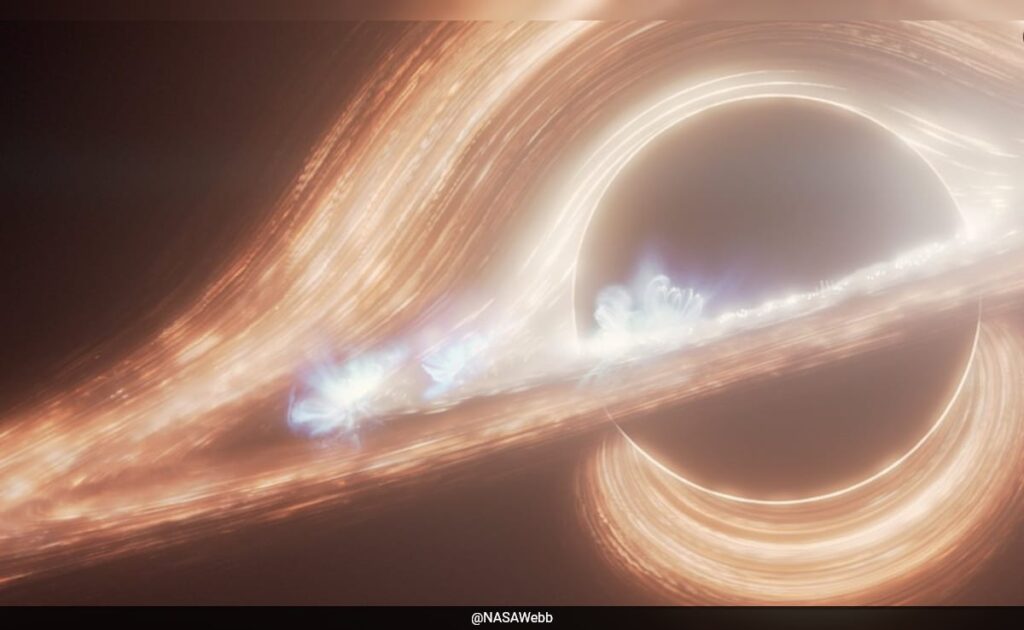

Astronomers have observed a flare of light near Sagittarius A, the supermassive black hole at the centre of the Milky Way galaxy. These bursts happen daily; some last seconds, others shine for a bit longer.
Using the James Webb Space Telescope, astronomers got the most detailed look at this black hole activity. The study builds on previous findings that show Sagittarius A is highly energetic, as per CNN.
Black holes are invisible, but the light comes from a spinning disk of hot gas and dust called the accretion disk. The findings published in The Astrophysical Journal Letters state that this disk sits just outside the event horizon, the point where gravity is so strong that nothing can escape, not even light.
Astronomer Yusef-Zadeh explained that flares are expected in all supermassive black holes, but Sagittarius A is unique. Unlike others, it is constantly active and never settles into a steady state. Observations made throughout 2023 and 2024 revealed changes every time, with each viewing showing something new.
Using Webb’s NIRCam instrument, Yusef-Zadeh and his colleagues observed Sagittarius A for 48 hours every eight to 10-hours over the course of a year. The team spied five to six big flares a day as well as smaller flashes of light in between.
According to Mr Zadeh, the black hole’s changing activity is likely caused by the unpredictable flow of material into the accretion disk.
The team suggests that the short bursts of light result from small, turbulent shifts within the disk, which may compress hot, energetic gas known as plasma and trigger flashes of radiation.
The larger and longer flares may be caused by magnetic reconnection events, where two magnetic fields near the black hole collide and release high-energy particles, moving close to the speed of light, said Mr Zadeh.
Mark Morris, a distinguished research professor in physics and astronomy at UCLA, said the new study confirmed the black hole experienced continuous changes, a pattern previously observed.
Although he was not involved in the research, Mr Morris noted that X-ray astronomers have found strong evidence suggesting that within the past few hundred years, at least one or possibly two massive flares have occurred. These flares were 10,000 to 100,000 times more intense than anything detected in the last 25 years of close monitoring of Sagittarius A.
The cause of these powerful flares remains a mystery. However, astronomers speculate that the black hole may have gobbled up a planet a few hundred years ago, said Mr Morris.


