
Related News

While staying at the Imperial Hotel in Tokyo during a lecture tour, Albert Einstein found himself in an awkward situation. A hotel bellboy had delivered a message to his room,

Have you ever wondered why rockets eventually tilt themselves after launch? Most people assume a rocket’s goal is to fly as high as possible, but ‘up’ is only the first

The Sombrero galaxy and its glowing halo of stars have never looked this good. The US National Science Foundation’s NOIRLab released the latest photo of the popular hat-shaped galaxy on

Researchers in China have discovered the 11th new lunar mineral, ‘Cerium–Magnesium Changesite,’ from the first Moon meteorites recovered in China. This important advancement, announced by the China Geological Survey, represents

China’s space mission (AP image) China has selected two Pakistani astronauts as candidates for its space programme, according to the state’s Manned Space Agency.In a statement issued on Wednesday, the

Challenge to Elon Musk’s SpaceX: Jeff Bezos’ Blue Origin to attempt first reused booster launch of New Glenn rocket Blue Origin, the US space company founded by Jeff Bezos, is

Trending News

In today’s digital age, the opportunity to make money online without any initial investment is more accessible than ever before. Whether you’re a student looking to earn some pocket money,

In today’s digital world, make money online has become a dream many want to turn into reality. Whether you’re looking for a side hustle or aiming to build a full-time

JSW Cement, the building materials arm of Sajjan Jindal-led JSW Group, has reduced the size of its upcoming initial public offering (IPO) to Rs 3,600 crore and will open the

The agricultural Gross Value Added (GVA) growth is expected to moderate to 4.5% in the first quarter of FY26, down from 5.4% in the preceding quarter, according to a report

Foreign portfolio investors (FPIs) turned net sellers in the Indian equity market in July, pulling out Rs 17,741 crore amid rising global trade tensions. According to data from NSDL, this

Avenue Capital Group-backed Asset Reconstruction Company (India) Ltd (ARCIL) has filed its draft red herring prospectus (DRHP) with markets regulator Sebi on Friday to raise funds through an initial public

NASA’s new plasma engine could reduce travel time to Mars |

Word Count: 341 | Estimated Reading Time: 2 minutes


NASA’s new plasma engine could reduce travel time to Mars

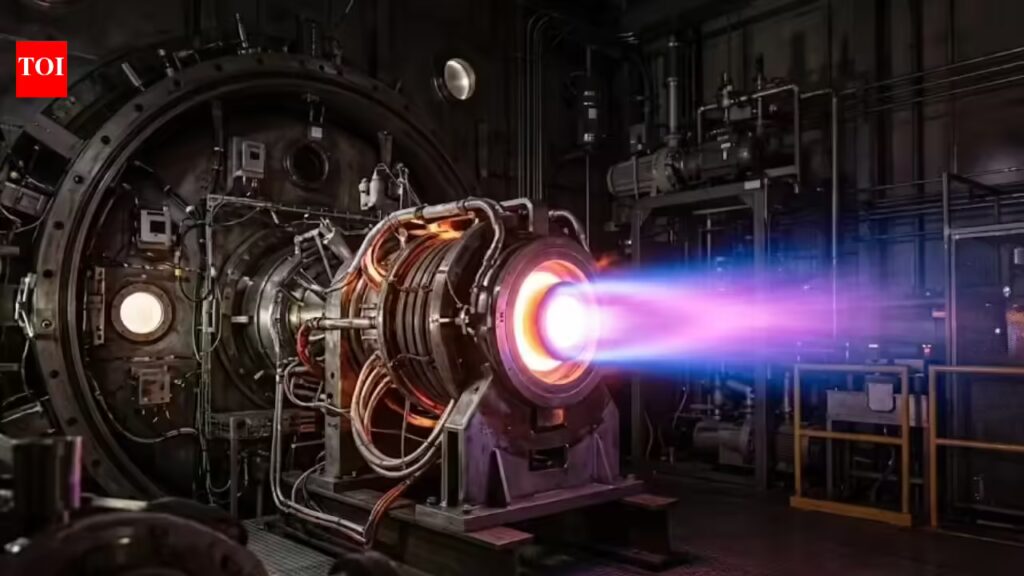
NASA’s Jet Propulsion Laboratory recently reached a significant achievement in space travel technology. They successfully tested a lithium-fed magnetoplasmadynamic (MPD) thruster, establishing a domestic power milestone for power output in the United States with 120 kilowatts. Unlike traditional rockets, this engine uses electromagnetic fields to accelerate ionised lithium plasma, providing the necessary thrust for missions carrying heavy loads. As NASA gears up for its ‘Moon to Mars’ mission, this advancement proves essential for nuclear-electric propulsion systems. It could reduce travel time and increase cargo capacity, paving the way for human exploration of Mars.

Travel time to Mars could change forever with NASA’s new plasma propulsion system

The latest experiments at NASA Jet Propulsion Laboratory centred on a lithium-based magnetoplasmadynamic (MPD) thruster. This technology transforms electrical energy into thrust by propelling ionised gas, or plasma, through a magnetic field. During the test, the central tungsten electrode in the thruster exceeded 5,000 degrees Fahrenheit. As a result, it produced an intense and fast-moving plume of lithium vapour. Efficiency here is gauged by specific impulse, which determines how much propellant is used efficiently, like optimising mass-flow efficiency. This makes it ideally suited for handling the massive payload requirements of a crewed Mars mission.

Why Mars exploration demands megawatt-class power

According to the report made on NASA Jet Propulsion Laboratory, the 120-kilowatt test is a big step forward, but missions to Mars will need much more power, around 2 to 4 megawatts. This JPL test shows that scaling up electromagnetic propulsion is possible. It uses lithium as fuel, which helps prevent engine parts from wearing out quickly. This makes the system more reliable for long trips in space.

NEP transports heavy life-support systems efficiently

NASA is looking into Nuclear Electric Propulsion (NEP) to generate the power needed for electromagnetic thrusters in areas far from the sun. Instead of relying on sunlight, a small nuclear reactor supplies continuous electricity to the MPD thruster. This setup is seen as the best way right now to efficiently transport heavy equipment and life-support systems to Mars while using less propellant.


Source link

Most Popular Articles