


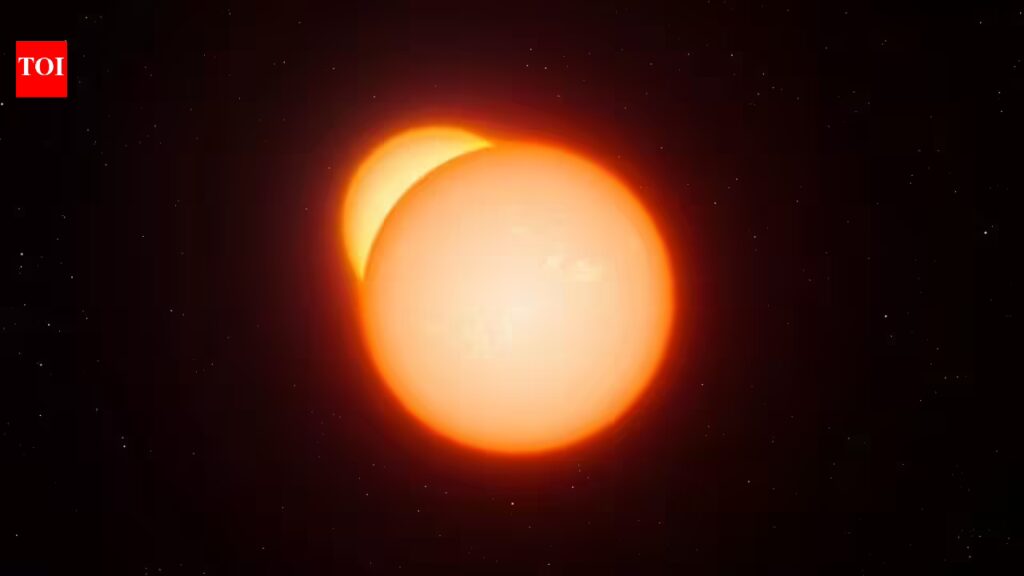

Astronomers have long wondered why planets orbiting two stars like the iconic Tatooine in Star Wars are so rare. You would expect them to be everywhere, really. Most stars form with planets, and a large fraction are born in pairs. Yet double-sun worlds are elusive. New research by University of Berkeley, suggests that the laws of physics, Einstein’s general relativity, could slowly push these planets into unstable orbits. Over millions of years, many get flung out or destroyed. What we see today is a skewed snapshot, a universe that appears emptier than it really is.
Why planets have a hard time orbiting two stars
Binary stars often orbit close together, and their gravitational pulls are anything but simple. A planet orbiting both feels a constantly changing tug. Its path slowly rotates, a process called orbital precession. It is a bit like a spinning top wobbling as it turns.The stars themselves precess too. General relativity plays a key role here. Over time, tidal forces pull them closer. That changes the game. The stars’ orbit speeds up, the planet slows down. Eventually, their rhythms match and chaos begins. When the precession rates align, the planet’s orbit stretches. At one point it swings far away, at another dangerously close to the stars. That is when trouble strikes.“Either the planet gets too close, or it is eventually ejected,” says Mohammad Farhat, a postdoc at UC Berkeley. “You end up losing the planet either way.”Only planets far from the stars survive. That is why circumbinary planets are rare. And it is not that they do not exist. They just avoid our telescopes. Planets in distant orbits rarely cross in front of their stars, making them invisible to Kepler or TESS.
Why planets rarely survive around close binary stars
Kepler and TESS expected to find hundreds of planets around tight binaries. Instead, only 14 confirmed circumbinary planets showed up, mostly orbiting stars that are not too tightly bound. A desert appears for binaries orbiting each other in less than seven days. That is exactly where we would expect to see them. Relativity and orbital chaos clear out that region.The universe makes these double-sun worlds rare, not because they cannot form, but because physics gently nudges them away from danger and often to their doom. The same physics behind Mercury’s orbit around the Sun explains it. Massive objects orbiting close together experience relativistic precession. For binary stars, the effect becomes dramatic over billions of years. The planet’s orbit is gradually warped until it either gets flung out or destroyed.


