
Related News

The Sombrero galaxy and its glowing halo of stars have never looked this good. The US National Science Foundation’s NOIRLab released the latest photo of the popular hat-shaped galaxy on

Researchers in China have discovered the 11th new lunar mineral, ‘Cerium–Magnesium Changesite,’ from the first Moon meteorites recovered in China. This important advancement, announced by the China Geological Survey, represents

China’s space mission (AP image) China has selected two Pakistani astronauts as candidates for its space programme, according to the state’s Manned Space Agency.In a statement issued on Wednesday, the

Challenge to Elon Musk’s SpaceX: Jeff Bezos’ Blue Origin to attempt first reused booster launch of New Glenn rocket Blue Origin, the US space company founded by Jeff Bezos, is

MUMBAI: Three days after the successful splashdown of Artemis-2, the Trump administration on Tuesday issued a memorandum which among other things includes safely deploying nuclear reactors in space orbit as

BENGALURU: In the vast hierarchy of the universe, the smallest galaxies are often overlooked. But a new study now suggests they may hold clues to one of astronomy’s most persistent

Trending News

In today’s digital age, the opportunity to make money online without any initial investment is more accessible than ever before. Whether you’re a student looking to earn some pocket money,

In today’s digital world, make money online has become a dream many want to turn into reality. Whether you’re looking for a side hustle or aiming to build a full-time

JSW Cement, the building materials arm of Sajjan Jindal-led JSW Group, has reduced the size of its upcoming initial public offering (IPO) to Rs 3,600 crore and will open the

The agricultural Gross Value Added (GVA) growth is expected to moderate to 4.5% in the first quarter of FY26, down from 5.4% in the preceding quarter, according to a report

Foreign portfolio investors (FPIs) turned net sellers in the Indian equity market in July, pulling out Rs 17,741 crore amid rising global trade tensions. According to data from NSDL, this

Avenue Capital Group-backed Asset Reconstruction Company (India) Ltd (ARCIL) has filed its draft red herring prospectus (DRHP) with markets regulator Sebi on Friday to raise funds through an initial public

Watch the Earth split in real time: First-ever video reveals 2.5-meter fault slip in seconds caused by an earthquake |

Word Count: 734 | Estimated Reading Time: 4 minutes


Watch the Earth split in real time: First-ever video reveals 2.5-meter fault slip in seconds caused by an earthquake

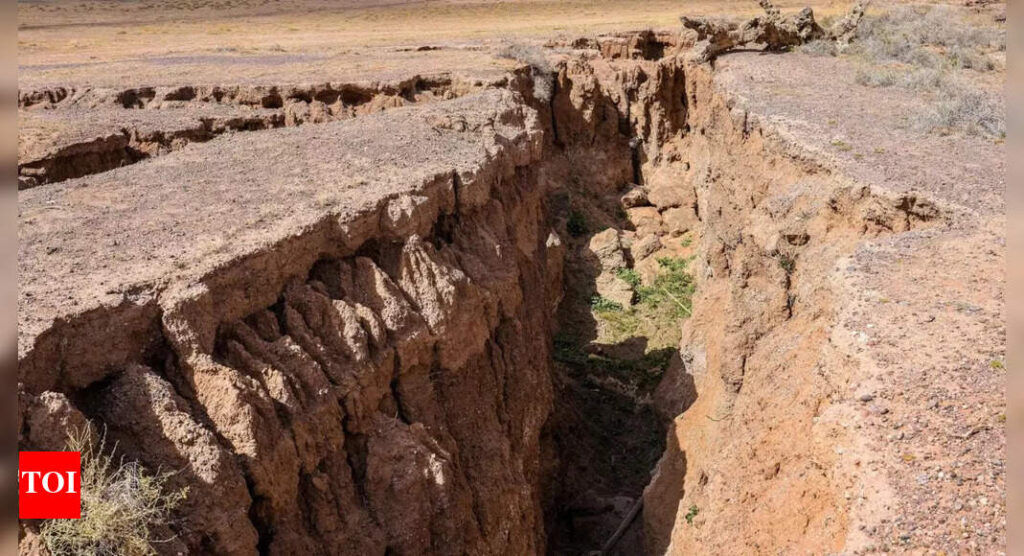
In March 2025, central Myanmar was struck by a powerful 7.7 magnitude earthquake—the strongest to hit the region in over a century and one of the deadliest in its modern history. What sets this seismic event apart is the capture of the fault’s sudden rupture in real time by a nearby CCTV camera, marking the first-ever video evidence of such rapid ground movement during an earthquake. The footage vividly shows the Earth’s surface splitting and slipping sideways by an impressive 2.5 meters in just 1.3 seconds. This rare visual record provides scientists with an unprecedented opportunity to study the detailed mechanics of earthquake fault slips, advancing our understanding of seismic behaviour and potentially transforming how future earthquakes are analysed and predicted.

Myanmar earthquake and rare real-time footage of 2.5 metre fault

On March 28, 2025, the Sagaing Fault near Mandalay, Myanmar’s second-largest city, ruptured in a strike-slip earthquake where two blocks of earth slid past each other horizontally. This earthquake was both powerful and deadly, shaking the region unlike any event in recent memory. What makes this event groundbreaking is the CCTV footage that captured the fault slipping in real time, a phenomenon never before recorded on video. Unlike previous studies relying on distant seismic sensors, this footage offers a direct visual record of the fault movement.

Pulse-like rupture and curved slip – Analysis of Myanmar earthquake rupture

Detailed analysis reveals pulse-like rupture and curved slip path

Researchers from Kyoto University analyzed the footage using a pixel cross-correlation technique, measuring the fault’s rapid 2.5-meter slip at speeds up to 3.2 meters per second. The slip lasted only 1.3 seconds, confirming a pulse-like rupture — a short, intense burst of movement traveling along the fault, similar to a ripple across a rug. The study also showed the fault slip path was subtly curved, challenging earlier ideas of purely linear fault ruptures and aligning with geological observations worldwide.

New frontiers in earthquake science and future research

This first-of-its-kind video observation offers powerful new tools for seismologists to understand fault behavior and earthquake mechanics. Capturing such detailed fault movement in real time will improve earthquake models and help better predict the ground shaking in future events, which is crucial for disaster preparedness. The research team plans to further explore the factors controlling fault slip shape and speed through physics-based simulations, hoping to unlock deeper insights into earthquake dynamics globally.


Source link

Most Popular Articles