


Related News

Signage ahead of the Nvidia Live event at CES 2026 in Las Vegas, Nevada, US, on Monday, Jan. 5, 2026. Bridget Bennett | Bloomberg | Getty Images Nvidia director Persis

Databricks co-founder and CEO Ali Ghodsi. Databricks Data analytics software company Databricks has landed $1.8 billion in fresh debt, a person familiar with the matter told CNBC. Databricks now sits

The Intel logo is visible at the India Mobile Congress 2025 in Delhi, India, on October 11, 2025. Kabir Jhangiani | Nurphoto | Getty Images Intel shares plunged 14% Friday

Nvidia founder and CEO Jensen Huang (R) speaks next to BlackRock chairman and WEF co-chairman Larry Fink during the World Economic Forum (WEF) annual meeting in Davos on January 21,

What looks invisible to the naked eye is now easy to spot. A portable medical device developed by Chinese firm Vivolight has gone viral after a short demo clip was

The TikTok USDS (U.S. Data Security) logo appears on a smartphone screen in this illustration photo in Reno, United States, on Dec. 19, 2025. Jaque Silva | Nurphoto | Getty

Trending News

In today’s digital age, the opportunity to make money online without any initial investment is more accessible than ever before. Whether you’re a student looking to earn some pocket money,

In today’s digital world, make money online has become a dream many want to turn into reality. Whether you’re looking for a side hustle or aiming to build a full-time

JSW Cement, the building materials arm of Sajjan Jindal-led JSW Group, has reduced the size of its upcoming initial public offering (IPO) to Rs 3,600 crore and will open the

The agricultural Gross Value Added (GVA) growth is expected to moderate to 4.5% in the first quarter of FY26, down from 5.4% in the preceding quarter, according to a report

Foreign portfolio investors (FPIs) turned net sellers in the Indian equity market in July, pulling out Rs 17,741 crore amid rising global trade tensions. According to data from NSDL, this

Avenue Capital Group-backed Asset Reconstruction Company (India) Ltd (ARCIL) has filed its draft red herring prospectus (DRHP) with markets regulator Sebi on Friday to raise funds through an initial public

‘Job security, flexibility top priorities for Indians’

Word Count: 664 | Estimated Reading Time: 4 minutes


'Job security, flexibility top priorities for Indians'

NEW DELHI: Traditional incentives like salary seem to have become less significant this year for Indian employees as workplace flexibility, job security, opportunities for learning and development and sense of belonging take centre stage, according to talent firm Randstad.
Last year, employees prioritised work-life balance, followed by remuneration and job security. According to Randstad India’s Workmonitor 2025 survey, 52 per cent of the Indian workforce would leave a job if it lacked sufficient flexibility, compared to 31 per cent globally. Flexibility continues to be a key decision-making factor, with 60 per cent of employees rejecting a job without flexible working hours and 56 per cent declining roles lacking flexibility in work locations, the survey added.
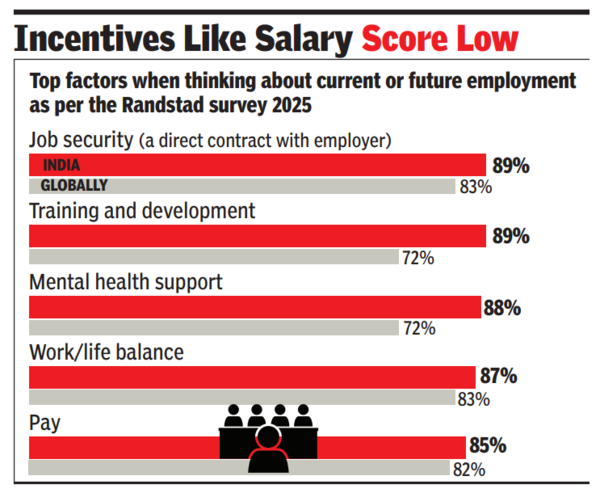
Incentives like salary score low

The findings indicate that employees are increasingly prioritising work that resonates with their personal values and life goals, moving beyond financial incentives. Job security, mental health support, and work-life balance now hold more significance. In fact, pay has dropped to the fourth spot, reflecting a shift toward a more holistic view of employment.
Further, the demand for flexible working hours is significantly higher across all generations in India compared to the global average due to unique socio-economic and workplace dynamics.
Viswanath PS, MD & CEO, Randstad India, said, “The generational divide in Indian workplace expectations is narrowing, and the data is clear – flexibility is no longer a benefit; it’s a baseline expectation across all age groups. Whether it’s Gen Z entering the workforce, millennials balancing career growth with personal commitments or Gen X in leadership roles, everyone values the ability to work on their own terms. This shift signals a fundamental change for organizations – flexibility must be embedded into work design, not treated as a perk. Equally, the demand for continuous learning highlights that talent isn’t just looking for jobs – they are looking for careers that evolve with them.”
Gen Z (62 per cent vs 45 per cent globally) received flexible working hours as they enter a digital-first job market where long commutes, cultural expectations around family involvement and high job competition make work-life balance essential.


Source link

Most Popular Articles