
Related News

SoftBank CEO Masayoshi Son and OpenAI CEO Sam Altman attend an event to pitch AI for businesses in Tokyo, Japan Feb. 3, 2025. Kim Kyung-Hoon | Reuters OpenAI and SoftBank

Meta has cut a trio of deals to power its artificial intelligence data centers, securing enough energy to light up the equivalent of about 5 million homes. The parent company

The Intel logo is displayed on a sign in front of Intel headquarters in Santa Clara, California, on July 16, 2025. Justin Sullivan | Getty Images Intel stock climbed 6%

Millions of Americans who use Gmail are getting a new package of tools, driven by artificial intelligence. Google says it’s trying to make Gmail more like a personal assistant as

The logo for MiniMax Group Inc. on a smartphone in Shanghai, China. Bloomberg | Bloomberg | Getty Images China-based AI startup MiniMax surged as much as 90% on its first

Crew-11 mission astronauts wave as they depart the Neil A. Armstrong Operations and Checkout Building en route to launch complex LC-39A at the Kennedy Space Center in Cape Canaveral, Florida

Trending News

In today’s digital age, the opportunity to make money online without any initial investment is more accessible than ever before. Whether you’re a student looking to earn some pocket money,

In today’s digital world, make money online has become a dream many want to turn into reality. Whether you’re looking for a side hustle or aiming to build a full-time

JSW Cement, the building materials arm of Sajjan Jindal-led JSW Group, has reduced the size of its upcoming initial public offering (IPO) to Rs 3,600 crore and will open the

The agricultural Gross Value Added (GVA) growth is expected to moderate to 4.5% in the first quarter of FY26, down from 5.4% in the preceding quarter, according to a report

Foreign portfolio investors (FPIs) turned net sellers in the Indian equity market in July, pulling out Rs 17,741 crore amid rising global trade tensions. According to data from NSDL, this

Avenue Capital Group-backed Asset Reconstruction Company (India) Ltd (ARCIL) has filed its draft red herring prospectus (DRHP) with markets regulator Sebi on Friday to raise funds through an initial public

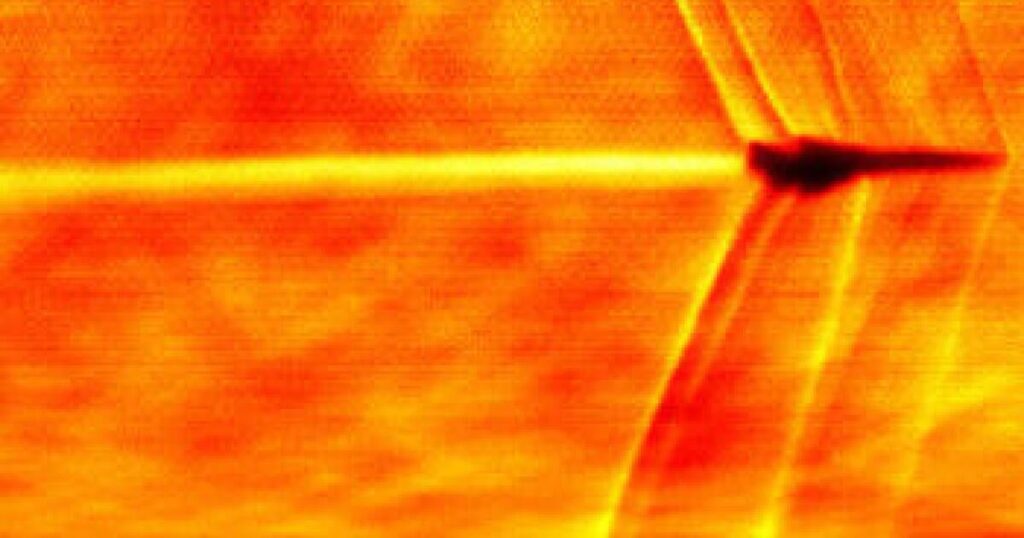
Remarkable NASA photo captures U.S. civilian jet breaking the sound barrier: “Makes the invisible visible”

Word Count: 363 | Estimated Reading Time: 2 minutes


A little over a month after a civilian jet broke the sound barrier, Boom Supersonic and NASA have released a photo of one of the aircraft’s historic test flights over the Mojave Desert.

The image released Monday shows the XB-1 aircraft, which Boom Supersonic said is the “first civil supersonic jet made in America,” during its second supersonic flight on Feb. 10. The company said it partnered with NASA using a technique known as Schlieren photography to visualize what can’t be seen with the naked eye.

“This image makes the invisible visible,” Boom Supersonic founder and CEO Blake Scholl said in a news release.

Boom-XB-1-Schlieren
Image provided by Boom Supersonic and NASA shows XB-1 breaking the sound barrier for the second time.

NASA/Boom Supersonic Handout


Chief test pilot Tristan “Geppetto” Brandenburg had to make sure XB-1 was in the right place at the right time to allow NASA’s team on the ground to photograph it in-flight as it eclipsed the sun, the Colorado-based company said. Crews used telescopes with special filters that can detect air distortions like shock waves to capture the image.

The photo was taken during the XB-1’s 13th overall test flight, according to the company, but it was the second time it flew at supersonic speed, this time reaching Mach 1.18, or 772 mph, Boom Supersonic said.

Scholl said that the XB-1 didn’t make an audible sonic boom that typically occurs when an aircraft is flying faster than the speed of sound. The captured data suggests that, at certain speed and atmospheric conditions, the sonic boom refracts in the atmosphere and never reaches the ground. The finding may lead the way for supersonic commercial flights without sonic booms, the company said in its news release.

NASA first visually captured supersonic shock waves in 2019 after a decade of research. The technology was developed in part to aid the space agency in testing its own supersonic aircraft, X-59.

“Knowing where the air is really moving tells you a lot about what your vehicle is doing, how efficient it is, and how you can make it better,” Ed Haering, principal investigator for the Schlieren photography, said in a 2023 NASA news release.


Source link

Most Popular Articles